
These are complementary study notes provided free of charge, produced as an Open Educational Resource by E2 Innovations LLC for Virginia Research Institute.
Adapted from OpenStax Astronomy 2e by Andrew Fraknoi, David Morrison, and Sidney Wolff, available free at openstax.org, used under the Creative Commons Attribution-NonCommercial-ShareAlike 4.0 International License (CC BY-NC-SA 4.0). The text has been rewritten and condensed; figures are drawn from OpenStax Astronomy 2e and its original sources.
This adaptation is likewise released under CC BY-NC-SA 4.0. If you share, adapt, or build upon these notes, please attribute both OpenStax and E2 Innovations LLC / Virginia Research Institute, and keep them free.
Module 1Science and the Sky, Orbits and Gravity, and the Earth, Moon, and Sky
This module introduces astronomy and the habits of scientific thinking, then follows our growing understanding of the sky: the patterns overhead and the models of the ancient world, the laws of motion and gravity that govern the heavens, and the familiar cycles of the seasons, the Moon, and eclipses. It contains four chapters, and each chapter pairs with one of the module lectures, covering the same ideas, equations, and examples.
Chapter 1. Science and the Universe: A Brief Tour
Adapted from OpenStax Astronomy 2e (CC BY-NC-SA 4.0). Complementary notes provided free of charge by E2 Innovations LLC for Virginia Research Institute.
Pairs with Lecture 1, The Nature of Astronomy and Science
Learning Objectives
After completing this chapter, you should be able to:
Describe what astronomy studies and how it differs from laboratory sciences.
Explain the steps of the scientific method and the meaning of a scientific theory.
Explain why the laws of nature are assumed to hold everywhere.
Use scientific notation and the light year, and relate light travel time to distance.
Describe the ladder of scales from the Earth to the realm of galaxies.
Astronomy is the study of everything beyond the Earth: the Sun, the Moon, the planets, the stars, and the universe as a whole. It is the oldest of the sciences, and in a sense the grandest, because its subject has no boundary. This chapter introduces two things every student of astronomy needs from the start: how we come to know anything about the universe, and how to grasp the enormous scales involved.
1.1 What Astronomy Is
Astronomy asks how the objects of the universe formed, how they behave, and how they relate to one another. It differs from most sciences in one important way: we usually cannot touch or experiment on the things we study. Instead, almost everything we know arrives as light and other radiation from far away, which we collect and analyze. Learning to read that light is the central skill of the science.
1.2 How Science Works
Science is not a fixed collection of facts but a method for testing ideas against nature. It begins with careful observation, then proposes a hypothesis, a tentative explanation. A good hypothesis makes predictions about what we should observe if it is true, and those predictions are tested against fresh observations. An idea that survives many such tests, and that ties together a wide range of facts, earns the name of a theory, which in science means a well tested explanation, not a mere guess.
A key feature of any scientific idea is that it must be testable: there must be some possible observation that could show it to be wrong. A claim that no observation could ever contradict lies outside science. Astronomy fits the scientific method fully, even without laboratory experiments, because we test ideas by predicting what we should see in the sky and then looking to check.
1.3 The Laws of Nature Are Universal
A foundational assumption of astronomy, confirmed again and again, is that the same physical laws operate everywhere in the universe. The gravity that makes an apple fall is the gravity that holds the Moon in its orbit and binds galaxies together, and light from a distant star obeys the same rules as light from a candle. This universality is what allows us to study places we can never visit. A striking example is the element helium, which was first identified in the light of the Sun, and named after the Greek word for the Sun, before it was ever found on Earth.
1.4 The Language of Large Numbers
The quantities in astronomy are far beyond everyday experience, so astronomers use scientific notation, a compact way of writing very large and very small numbers as a digit times a power of ten. For example, the Sun is about 150,000,000 kilometers away, which is written as 1.5 times ten to the eighth power kilometers. Distances between stars are so great that astronomers use the light year, the distance light travels in one year, as a unit of length. The nearest star beyond the Sun is more than four light years away.
1.5 Light as a Cosmic Messenger and Time Machine
Because light travels at a finite speed, about three hundred thousand kilometers per second, it takes time to reach us. This means that to look out into space is also to look back in time. The time for light to travel a distance is the distance divided by the speed of light.
Worked example: light travel time from the Sun. Light travels about 300,000 kilometers per second, and the Sun is about 150 million kilometers away. Dividing the distance by the speed of light gives the travel time:

So the sunlight you see left the Sun about eight minutes ago. The same reasoning, on a far larger scale, means a galaxy a million light years away is seen as it was a million years in the past. The farther away we look, the further back in time we see.
1.6 A Journey Through the Scales of the Universe
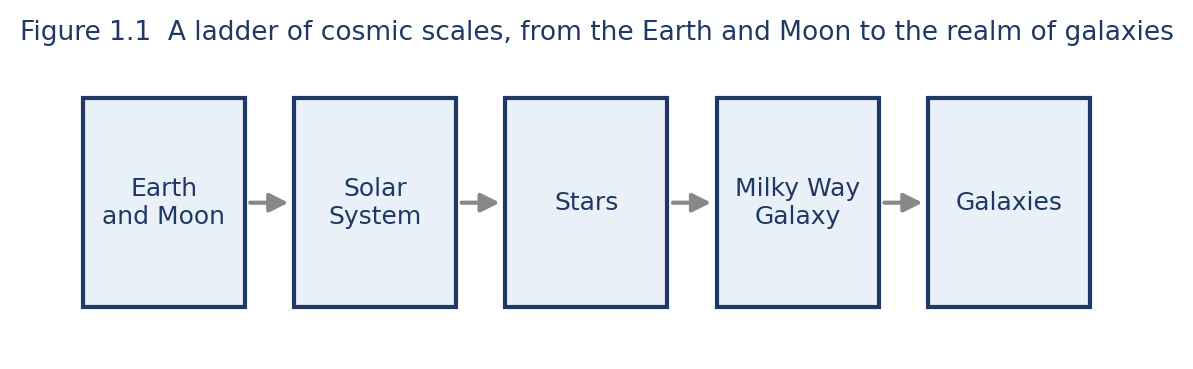
It helps to picture the universe as a series of nested scales. Closest is the Earth and its Moon, then the Sun and the family of planets that make up the solar system. Far beyond the planets lie the stars, and the Sun is one ordinary star among them. Hundreds of billions of stars gather into the Milky Way Galaxy, and the Milky Way is itself only one of hundreds of billions of galaxies spread through the observable universe.
Chapter Summary
Astronomy studies the universe beyond the Earth, and because we cannot experiment directly on most of it, we learn about it chiefly from the light it sends us. Science is a method of testing ideas against observation, in which a well tested explanation is called a theory and every scientific claim must be testable. The laws of nature are the same everywhere, and because light travels at a finite speed, looking outward means looking into the past. Astronomical distances are measured in light years, and the universe is best pictured as a ladder of scales from the Earth and Moon out to the realm of galaxies.
Key Terms
Astronomy: the scientific study of the objects and phenomena of the universe beyond the Earth
Hypothesis: a tentative, testable explanation proposed to account for observations
Theory: a well tested, well supported explanation that ties together many observations
Scientific notation: a compact way of writing very large or very small numbers as a digit times a power of ten
Light year: the distance light travels in one year, used as a unit of astronomical distance
Speed of light: the finite speed at which light travels, about three hundred thousand kilometers per second
Review Questions
1. A star is 100 light years away. How long ago did the light we now see from it leave the star?
Answer: 100 years, because a light year is the distance light travels in one year, so light from 100 light years away took 100 years to reach us.
2. Why can astronomers apply laws discovered on Earth to distant stars they can never visit?
Answer: Because the laws of nature are assumed, and observed, to be the same everywhere in the universe.
3. Is the claim there is an object that cannot be detected in any way, ever a scientific statement? Explain.
Answer: No. A scientific claim must be testable, and a claim that no possible observation could confirm or contradict lies outside science.
Chapter 2. Observing the Sky: The Birth of Astronomy
Adapted from OpenStax Astronomy 2e (CC BY-NC-SA 4.0). Complementary notes provided free of charge by E2 Innovations LLC for Virginia Research Institute.
Pairs with Lecture 2, Observing the Sky and the Birth of Astronomy
Learning Objectives
After completing this chapter, you should be able to:
Describe the celestial sphere and its main reference points.
Explain how the rotation and orbit of Earth cause the daily and yearly motions of the sky.
Describe key achievements of ancient astronomy, including the measurement of Earth’s size.
Distinguish the geocentric and heliocentric models and explain retrograde motion.
Explain how Galileo’s telescopic observations supported the heliocentric model.
Long before telescopes, people watched the sky with great care and built models to explain what they saw. This chapter follows that story, from the appearance of the sky as a great sphere turning overhead, through the achievements of ancient astronomers, to the revolution that moved the Earth from the center of the cosmos.
2.1 The Celestial Sphere
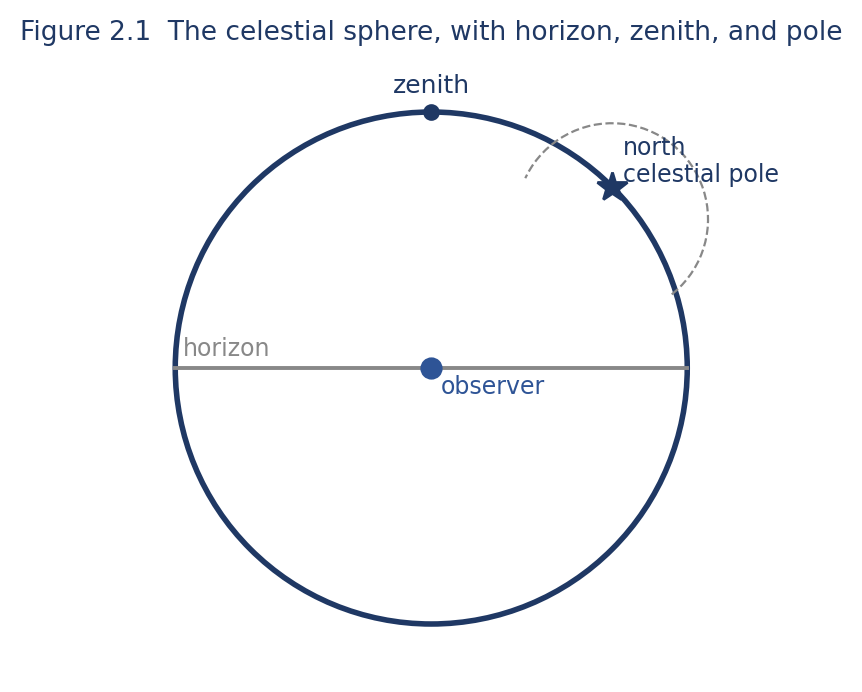
To an observer under a dark sky, the stars appear fixed to the inside of a vast dome that turns overhead through the night. Astronomers call this imaginary dome the celestial sphere. Although it is not a real object, it is a useful way to describe positions and motions. We define reference points on it: the horizon, where the sky meets the ground; the zenith, the point straight overhead; and the celestial poles, the points about which the whole sphere appears to turn. The North Star, Polaris, lies very close to the north celestial pole, so it barely moves while the other stars appear to circle it.
2.2 The Daily and Yearly Motions of the Sky
The nightly turning of the celestial sphere is not a real motion of the stars but a reflection of the rotation of the Earth on its axis. As the Earth turns, the stars appear to rise in the east and set in the west, just as the Sun does by day. Over a year, as the Earth orbits the Sun, the Sun appears to move slowly against the background stars, and different constellations become visible in different seasons.
2.3 Astronomy in the Ancient World
Without modern instruments, ancient astronomers made remarkably careful measurements. They tracked the Sun, Moon, and planets, kept calendars, and learned to predict eclipses. One famous achievement was the estimate of the size of the Earth by comparing the length of shadows cast at two cities a known distance apart on the same day.
Worked example: Eratosthenes measures the Earth. By measuring the angle of the Sun at two cities a known distance apart, the fraction of a full circle between them can be compared to the fraction of the Earth’s circumference between them:

From the small difference in the Sun’s angle and the distance between the cities, the circumference of the Earth was calculated, coming remarkably close to the modern value. It was geometry, applied to shadows, that first measured our planet.
2.4 The Geocentric Model
Most ancient thinkers placed a motionless Earth at the center of the cosmos, with the Sun, Moon, planets, and stars moving around it. This is the geocentric, or Earth centered, model, and it matched everyday experience, since the ground feels still and the sky appears to move. It was refined into a detailed system that could predict planetary positions fairly well and dominated astronomy for well over a thousand years. Its main difficulty was the occasional backward, or retrograde, motion of the planets, which required complicated additions to explain.
2.5 The Copernican Revolution and Galileo
Modern astronomy began when Copernicus proposed that the Sun, not the Earth, sits at the center, with the Earth just one of the planets orbiting it. This heliocentric, or Sun centered, model explained retrograde motion far more naturally, as an effect of the Earth overtaking or being overtaken by other planets. The idea was strengthened when Galileo turned the newly invented telescope to the sky and discovered moons circling Jupiter and phases of Venus, observations that fit the Sun centered picture and could not be explained by the old one.
Chapter Summary
The sky appears as a celestial sphere turning overhead, an effect produced by the rotation of the Earth, while the yearly change of the constellations reflects the Earth orbiting the Sun. Ancient astronomers measured the sky with great skill, even estimating the size of the Earth from shadows, and most favored a geocentric model. Modern astronomy began with the heliocentric model of Copernicus, which explained the planets more naturally, and Galileo’s telescopic discoveries of Jupiter’s moons and the phases of Venus supported the Sun centered view.
Key Terms
Celestial sphere: the imaginary sphere on which the stars appear to lie and which seems to turn overhead
Zenith: the point on the celestial sphere directly overhead an observer
Geocentric model: an Earth centered model of the cosmos, with the Sun and planets orbiting the Earth
Heliocentric model: a Sun centered model, with the Earth and other planets orbiting the Sun
Retrograde motion: the occasional apparent backward motion of a planet against the background stars
Review Questions
1. What causes the nightly rising and setting of the stars?
Answer: The rotation of the Earth on its axis, which makes the celestial sphere appear to turn overhead.
2. What was the main observational problem that the geocentric model struggled to explain?
Answer: The occasional retrograde, or backward, motion of the planets against the background stars.
3. Name one telescopic observation by Galileo that supported the heliocentric model.
Answer: The moons orbiting Jupiter, or the phases of Venus. Either shows motion that fits a Sun centered system.
Chapter 3. Orbits and Gravity
Adapted from OpenStax Astronomy 2e (CC BY-NC-SA 4.0). Complementary notes provided free of charge by E2 Innovations LLC for Virginia Research Institute.
Pairs with Lecture 3, Orbits and Gravity
Learning Objectives
After completing this chapter, you should be able to:
State Kepler’s three laws and apply the third law to simple orbits.
State Newton’s three laws of motion.
State Newton’s law of universal gravitation and apply its inverse square dependence.
Explain how measuring an orbit reveals the mass of the central body.
Copernicus placed the Sun at the center, but he did not explain exactly how the planets move or why. That came from Kepler, who found the true shape and rhythm of the orbits, and from Newton, who explained them with a single law of gravity reaching across the whole universe. This chapter presents those rules of motion.
3.1 Kepler’s Three Laws
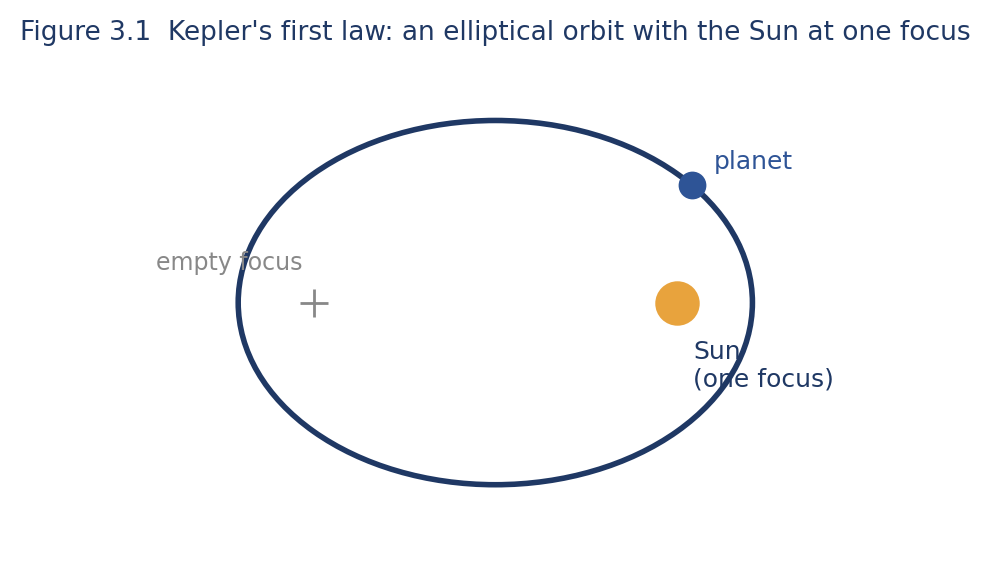
Working from unusually precise observations, Kepler discovered three rules. His first law states that each planet moves along an ellipse, an oval shape, with the Sun at one focus rather than at the center. His second law states that a planet moves faster when nearer the Sun and slower when farther, sweeping out equal areas in equal times. His third law connects a planet’s orbit to its distance.
Kepler’s third law can be written simply for objects orbiting the Sun, with the period P in years and the average distance a in astronomical units, where one astronomical unit is the average Earth to Sun distance:

Worked example: a planet four astronomical units from the Sun. Cubing the distance and taking the square root gives the orbital period:

3.2 Newton’s Laws of Motion
Kepler described how the planets move but not why. Newton supplied the reason with three general laws of motion. The first states that an object continues moving in a straight line at a steady speed unless a force acts on it. The second states that a force changes an object’s motion, and that a given force changes the motion of a light object more than that of a heavy one. The third states that forces always come in equal and opposite pairs.
3.3 Universal Gravitation
Newton’s greatest insight was that a single force, gravity, governs both falling objects on Earth and the motions of the heavens. His law of universal gravitation states that every mass attracts every other mass with a force that grows with the masses and weakens with the square of the distance between them:
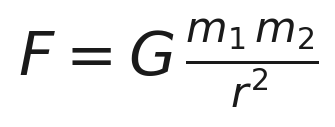
Here F is the gravitational force, G is a constant, the two masses are m one and m two, and r is the distance between them. Because the distance appears as its square in the denominator, gravity follows an inverse square law: the force falls off quickly as objects move apart.
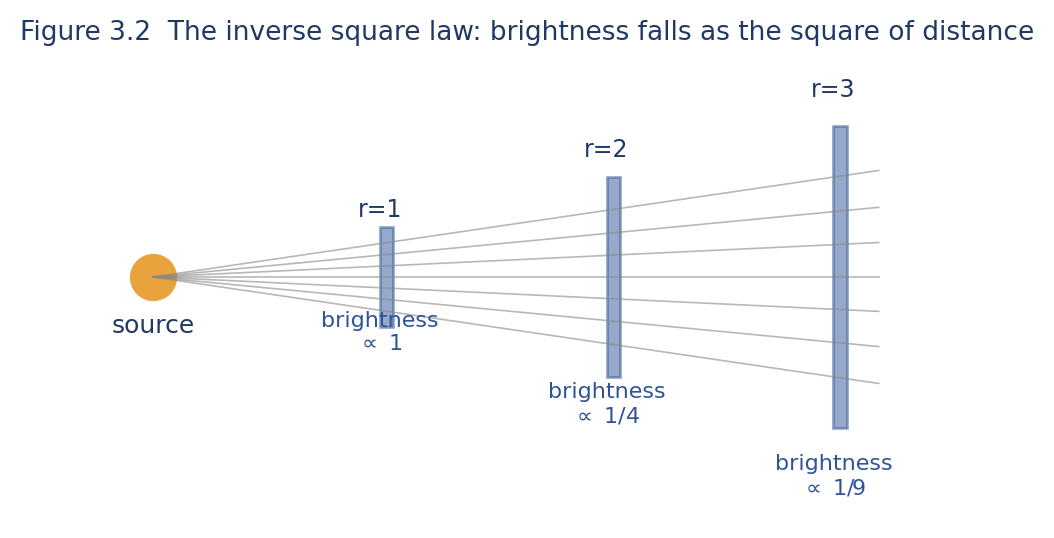
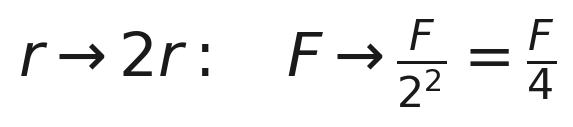
Worked example: doubling the distance. If the distance between two objects is doubled, the force drops to one quarter, because two squared is four:
3.4 Orbits and Weighing the Heavens
The rules of motion and gravity govern every orbit: moons around planets, spacecraft around the Earth, and stars around the center of a galaxy. Newton extended Kepler’s third law so that, if we can measure the period and size of an orbit, we can calculate the mass of the central body it circles. This makes orbits one of the most powerful tools in astronomy, because it lets us weigh the Sun, the planets, and even distant stars and galaxies simply by watching how things move around them.
Chapter Summary
Kepler’s three laws describe planetary motion: orbits are ellipses with the Sun at one focus, planets move faster when nearer the Sun, and the square of the period equals the cube of the distance in appropriate units. Newton explained these laws with his three laws of motion and his law of universal gravitation, in which every mass attracts every other with a force that weakens as the square of the distance. The same gravity governs all orbits, and by measuring an orbit astronomers can weigh the central body.
Key Terms
Ellipse: the oval shape of a planetary orbit, with the Sun at one focus
Astronomical unit: the average distance from the Earth to the Sun
Kepler’s third law: the rule that the square of the orbital period equals the cube of the average orbital distance, in appropriate units
Universal gravitation: Newton’s law that every mass attracts every other with a force that weakens as the square of the distance
Inverse square law: a relationship in which a quantity falls off as the square of the distance increases
Review Questions
1. A planet orbits the Sun at an average distance of 9 astronomical units. Using Kepler’s third law, what is its orbital period?
Answer: Period squared equals distance cubed, so P squared equals 9 cubed, which is 729, and P equals the square root of 729, which is 27 years.
2. If the distance between two masses is tripled, how does the gravitational force between them change?
Answer: It falls to one ninth, because the inverse square law divides the force by three squared, which is nine.
3. What can astronomers determine by measuring the period and size of an orbit?
Answer: The mass of the central body that the object is orbiting.
Chapter 4. Earth, Moon, and Sky
Adapted from OpenStax Astronomy 2e (CC BY-NC-SA 4.0). Complementary notes provided free of charge by E2 Innovations LLC for Virginia Research Institute.
Pairs with Lecture 4, Earth, Moon, and Sky
Learning Objectives
After completing this chapter, you should be able to:
Explain how the tilt of Earth’s axis causes the seasons.
Relate the day, month, and year to astronomical cycles.
Explain the cause of the phases of the Moon.
Explain why and when solar and lunar eclipses occur.
The most familiar events in the sky, the march of the seasons, the changing face of the Moon, and the drama of an eclipse, all follow from simple geometry: the tilt of the Earth, its motion around the Sun, and the orbit of the Moon. This chapter explains each in turn.
4.1 The Tilted Earth and the Seasons
The Earth’s axis of rotation is tilted about twenty three and a half degrees from vertical, and it keeps pointing in the same direction as the Earth orbits the Sun. This tilt, not any change in distance from the Sun, is the cause of the seasons. When your hemisphere is tilted toward the Sun, sunlight strikes it more directly and the days are longer, producing summer. Half a year later, when it is tilted away, the sunlight is more slanted and the days are shorter, producing winter. Because the two hemispheres are tilted in opposite directions, they have opposite seasons at the same time.
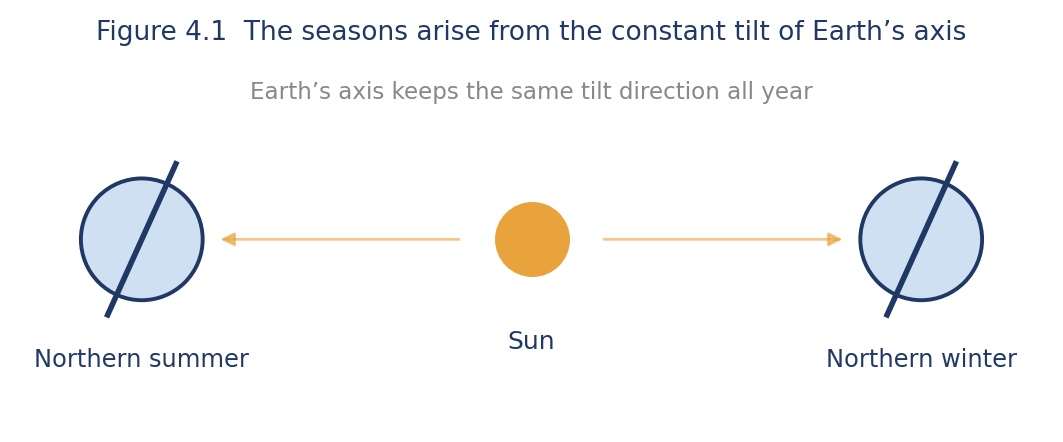
A common misconception. A frequent error is to think summer comes when the Earth is closest to the Sun. In fact the Earth is slightly closer to the Sun during northern winter. It is the tilt of the axis, which changes how directly sunlight falls, that causes the seasons, not the distance.
4.2 Timekeeping and the Sky
The motions of the sky are the original basis of timekeeping. The day is defined by the rotation of the Earth, the month is related to the cycle of the Moon’s phases, and the year is defined by the Earth’s orbit around the Sun. Because these natural cycles do not divide evenly into one another, calendars require adjustments, such as leap years, to stay in step with the seasons.
4.3 The Phases of the Moon
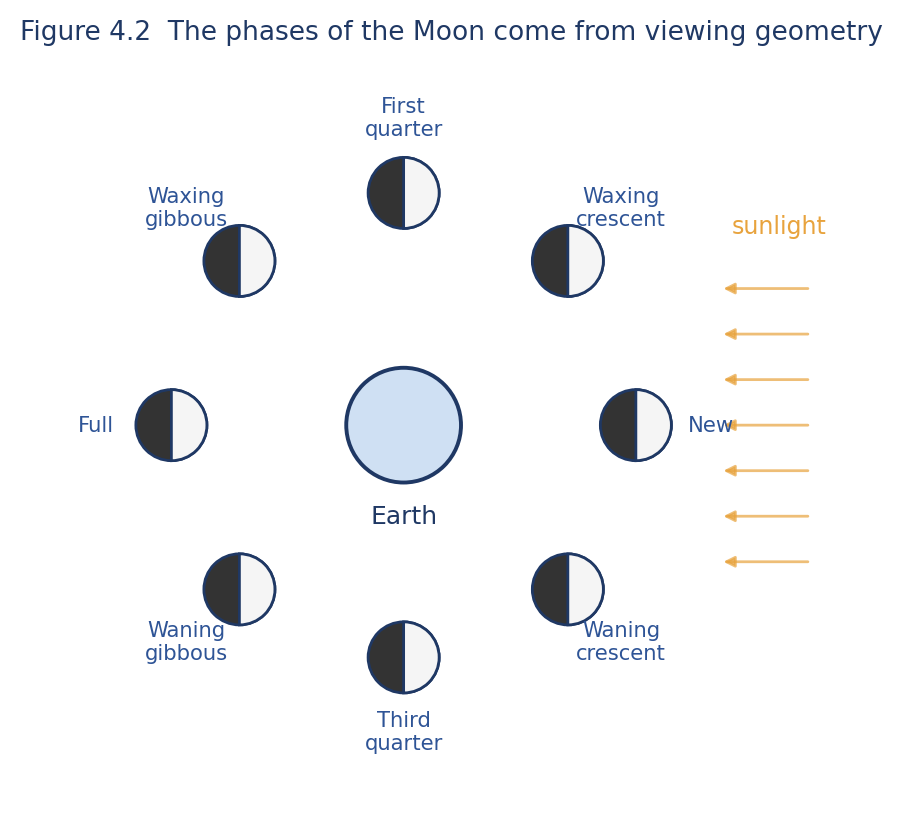
The Moon does not produce its own light; it shines by reflecting sunlight, and the Sun always lights one half of it. The phase we see depends on the angle between the Sun, the Moon, and the Earth as the Moon orbits us about once a month. When the Moon lies opposite the Sun in our sky, its fully lit face points toward us and we see a full moon. When it lies between us and the Sun, its dark side faces us and we see a new moon. In between, we see crescent and half lit shapes. The cycle of phases is entirely a matter of geometry and viewing angle, and it is not caused by the shadow of the Earth.
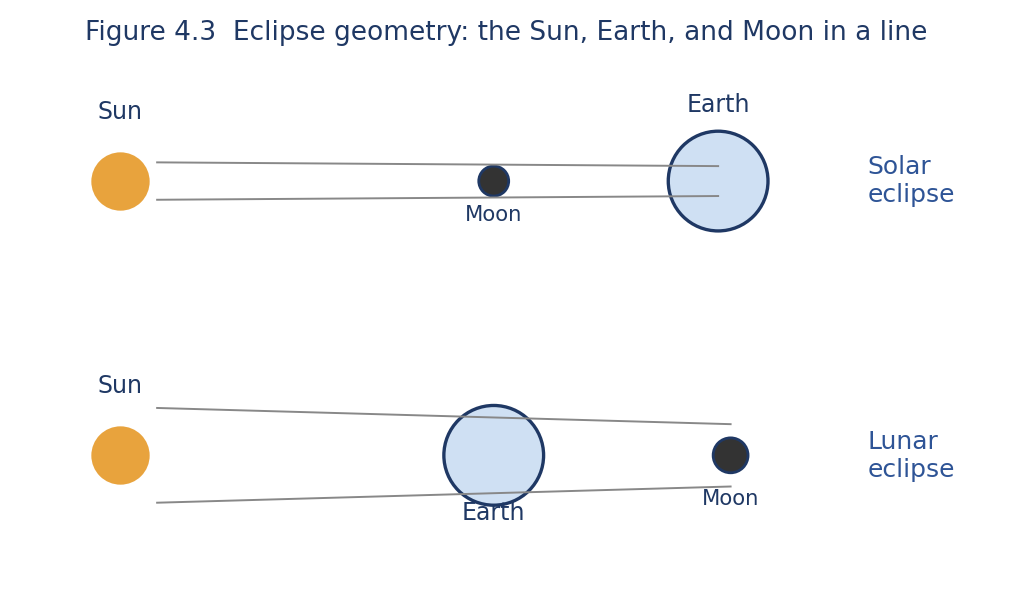
4.4 Eclipses of the Sun and Moon
An eclipse occurs when the Sun, Earth, and Moon line up so that one body casts its shadow on another. In a solar eclipse, the Moon passes between the Earth and the Sun and blocks the Sun’s light for observers within the Moon’s shadow. In a lunar eclipse, the Earth passes between the Sun and the Moon, and the Earth’s shadow falls across the Moon. Eclipses do not happen every month, because the Moon’s orbit is tilted slightly relative to the Earth’s orbit around the Sun, so most months the alignment is imperfect and the shadows miss.
Chapter Summary
The seasons are caused by the constant tilt of the Earth’s axis, which changes how directly sunlight strikes each hemisphere, not by any change in distance from the Sun. The natural cycles of the day, month, and year are the basis of timekeeping and calendars. The phases of the Moon result from the changing angle at which we view its sunlit half as it orbits the Earth, and eclipses occur only when the Sun, Earth, and Moon align closely enough for one to shadow another, which the tilt of the Moon’s orbit makes uncommon.
Key Terms
Axial tilt: the roughly twenty three and a half degree tilt of the Earth’s rotation axis, the cause of the seasons
Phase: the fraction of the Moon’s sunlit face visible from the Earth, changing through the month
New moon: the phase when the Moon lies between the Earth and the Sun and its dark side faces us
Full moon: the phase when the Moon lies opposite the Sun and its fully lit face points toward us
Solar eclipse: an event in which the Moon passes between the Earth and the Sun, blocking the Sun’s light
Lunar eclipse: an event in which the Earth passes between the Sun and the Moon, casting its shadow on the Moon
Review Questions
1. Why is it summer in the northern hemisphere when the north end of Earth’s axis is tilted toward the Sun?
Answer: Because sunlight then strikes the northern hemisphere more directly and the days are longer, which warms the surface.
2. We see a full moon when the Moon is in what position relative to the Earth and Sun?
Answer: When the Moon is on the far side of the Earth from the Sun, so its fully sunlit face points toward us.
3. Why does an eclipse not happen every month, even though the Moon orbits the Earth monthly?
Answer: Because the Moon’s orbit is tilted relative to the Earth’s orbit around the Sun, so usually the three bodies do not line up closely enough and the shadows miss.
Module 2How We Gather Light, and a First Look at Our Planetary Neighborhood
This module introduces the single most important tool in astronomy, light, and the instruments that gather it, then turns outward to the solar system as a whole and to the Earth as a planet. It contains four chapters, and each chapter pairs with one of the module lectures, covering the same ideas, equations, and examples.
Chapter 5. Radiation and Spectra
Adapted from OpenStax Astronomy 2e (CC BY-NC-SA 4.0). Complementary notes provided free of charge by E2 Innovations LLC for Virginia Research Institute.
Pairs with Lecture 1, Radiation and Spectra
Learning Objectives
After completing this chapter, you should be able to:
Describe light as electromagnetic radiation and identify the regions of the electromagnetic spectrum.
Explain how the color of a hot object reveals its temperature.
Explain how a spectrum reveals the composition of a distant object.
Distinguish continuous, absorption, and emission spectra.
Explain how the Doppler effect reveals motion toward or away from us.
Light is the messenger of astronomy. Almost everything we know about the universe arrives as light, so this chapter examines how light behaves, how it spreads across the electromagnetic spectrum, and how the light from an object reveals its temperature, its composition, and its motion. These are the tools that let us study objects we can never touch.
5.1 The Behavior of Light
Light behaves both as a wave and as a stream of particles called photons. As a wave, light has a wavelength, the distance between successive crests, and a shorter wavelength carries more energy per photon. All forms of light, whatever their wavelength, travel through empty space at the same speed, the speed of light, which is about three hundred thousand kilometers per second. Nothing in the universe travels faster.
This dual nature, wave and particle, is a foundation of modern physics, but for most of astronomy it is the wavelength of light that carries the information we need. By measuring the wavelengths present in the light from a star or galaxy, and how bright the light is, astronomers can read off a remarkable amount about the object that sent it.
5.2 The Electromagnetic Spectrum
The full range of wavelengths of light is called the electromagnetic spectrum. In order of decreasing wavelength and increasing energy, it runs from radio waves, through microwaves and infrared, to visible light, and on to ultraviolet, X rays, and gamma rays. Visible light, the small band our eyes detect, is only a thin slice of the whole. All of these are the same kind of radiation, differing only in wavelength and energy, so a gamma ray and a radio wave are the same phenomenon at very different wavelengths.
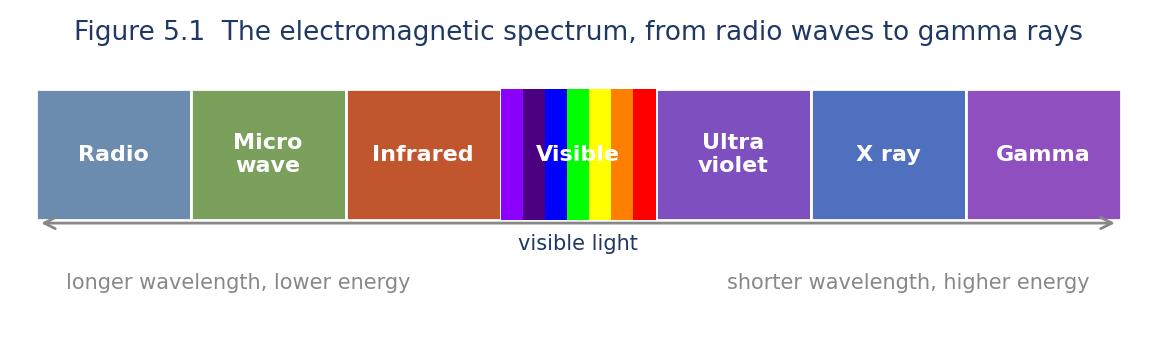
A hot, glowing object gives off light across a range of wavelengths, and the wavelength at which it is brightest depends on its temperature. Hotter objects glow bluer, with the peak of their light at shorter wavelengths, while cooler objects glow redder. This relationship can be stated as a simple proportion: the peak wavelength is inversely proportional to the temperature.

This is why the color of a star is a direct clue to its surface temperature: a blue white star is hotter than an orange red one. The same rule governs a heated piece of metal, which glows dull red when warm and white or blue as it grows hotter.
5.3 Spectroscopy in Astronomy
When light is spread out into its component wavelengths, the result is a spectrum. There are three basic kinds. A hot, dense object gives a continuous spectrum, an unbroken band of color. When light from such a source passes through a cooler thin gas, that gas absorbs certain wavelengths, leaving dark absorption lines in the spectrum. A hot, thin gas on its own instead glows at just those same wavelengths, producing bright emission lines.
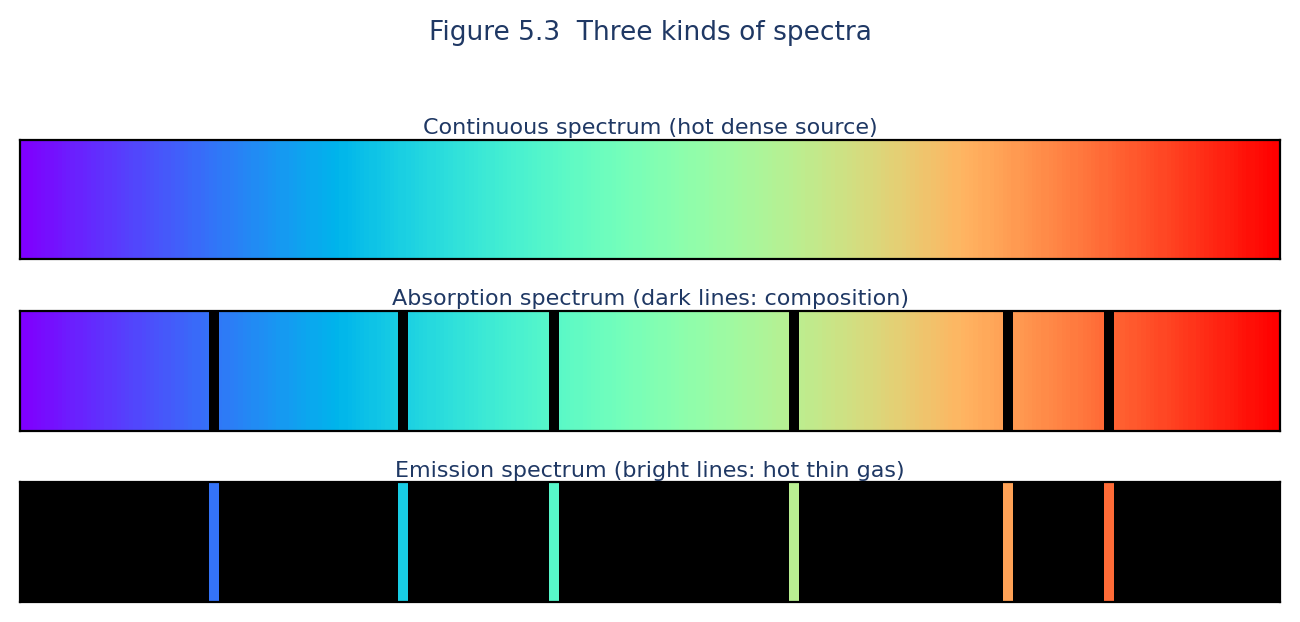
Each chemical element absorbs and emits light at its own particular set of wavelengths, leaving a pattern of lines that acts like a fingerprint. By reading these spectral lines, astronomers can determine which elements are present in a star or a gas cloud, even from across the galaxy, and stars turn out to be made mostly of hydrogen and helium. Spectroscopy, the study of spectra, is how we learn the composition of objects we can never sample directly, and it is one of the most powerful techniques in all of astronomy.
5.6 The Doppler Effect
The spectrum also reveals motion. When a source of light moves toward you, its waves are crowded into shorter wavelengths, shifting the spectral lines toward the blue. When it moves away, the waves are stretched to longer wavelengths, shifting the lines toward the red. This is the Doppler effect, the same phenomenon that raises the pitch of an approaching siren and lowers it as the siren departs.
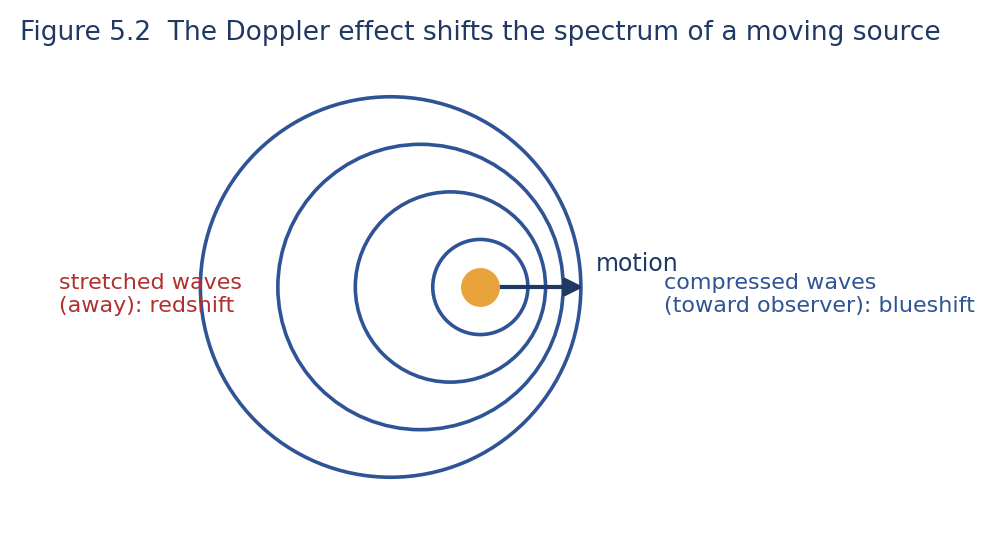
The size of the shift depends on how fast the source is moving. For speeds small compared with the speed of light, the fractional change in wavelength equals the speed of the source divided by the speed of light.
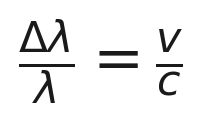
Worked example: reading a redshift. If the spectral lines of a star are shifted toward longer, redder wavelengths, the star is moving away from us. A larger shift means a faster motion. Measuring the shift, and dividing by the wavelength, gives the speed as a fraction of the speed of light. The same measurement, applied to galaxies, later revealed that the universe is expanding, one of the great discoveries of modern astronomy.
Chapter Summary
Light is electromagnetic radiation that behaves as both a wave and a stream of photons, and it spans a spectrum from radio waves to gamma rays, of which visible light is a thin slice. The color of a hot object reveals its temperature, with hotter objects bluer and cooler objects redder. Spectra come in three kinds, continuous, absorption, and emission, and the pattern of spectral lines acts as a fingerprint that reveals composition. The Doppler effect shifts those lines toward the blue for approaching objects and the red for receding ones, letting astronomers measure motion, including the expansion of the universe.
Key Terms
Electromagnetic spectrum: the full range of light by wavelength, from radio waves through visible light to gamma rays
Wavelength: the distance between successive crests of a light wave; shorter wavelengths carry more energy
Continuous spectrum: an unbroken band of color produced by a hot, dense source
Absorption lines: dark lines in a spectrum where a cooler gas has absorbed particular wavelengths
Emission lines: bright lines produced by a hot, thin gas at particular wavelengths
Doppler effect: the shift of light to shorter wavelengths for an approaching source and longer wavelengths for a receding one
Review Questions
1. A star appears distinctly blue white in color. Compared with a red star, what can you say about its temperature?
Answer: It is hotter, because bluer color corresponds to a higher surface temperature.
2. What produces the dark absorption lines seen in a star’s spectrum?
Answer: A cooler thin gas between us and the hot source absorbs particular wavelengths, leaving dark lines that identify the elements present.
3. The lines in a galaxy’s spectrum are shifted toward longer, redder wavelengths. Is the galaxy approaching or receding, and how do you know?
Answer: Receding, because a shift toward longer wavelengths is a redshift, which indicates motion away from us.
Chapter 6. Astronomical Instruments
Adapted from OpenStax Astronomy 2e (CC BY-NC-SA 4.0). Complementary notes provided free of charge by E2 Innovations LLC for Virginia Research Institute.
Pairs with Lecture 2, Astronomical Instruments
Learning Objectives
After completing this chapter, you should be able to:
Describe what a telescope does and why larger telescopes are more powerful.
Apply the rule that light gathering grows with the square of the mirror diameter.
Explain why astronomers observe across the whole electromagnetic spectrum.
Explain why some observations must be made from space.
If light is the message, telescopes are what gather it. This chapter examines what a telescope actually does, how astronomers observe across the whole spectrum, and why some kinds of light can only be collected from above the atmosphere.
6.1 Telescopes
A telescope does two main jobs. It collects light over a large area and brings it to a focus, so that faint objects become bright enough to study, and it reveals fine detail that the eye alone cannot see. A curved mirror or lens gathers the incoming light and concentrates it at a point called the focus, where a detector or instrument records it.
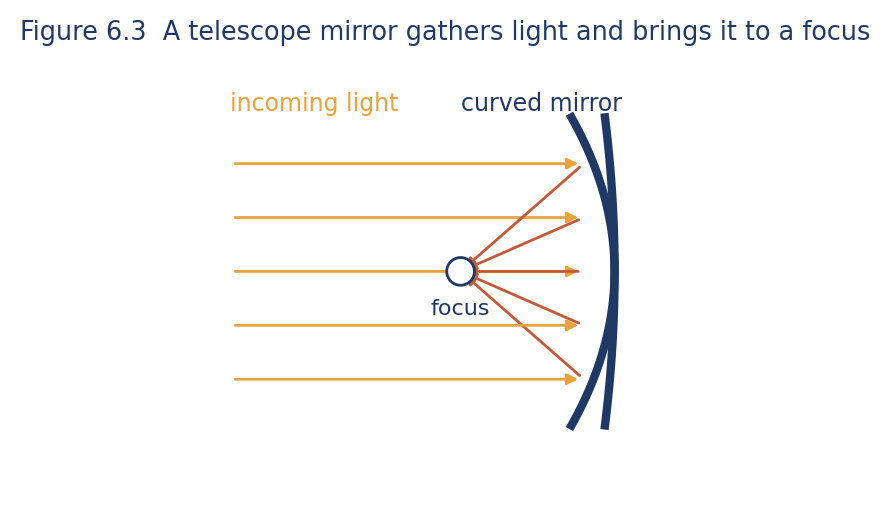
The larger the main mirror or lens, the more light the telescope gathers and the fainter the objects it can detect. The light gathering ability depends on the area of the mirror, which grows with the square of its diameter.

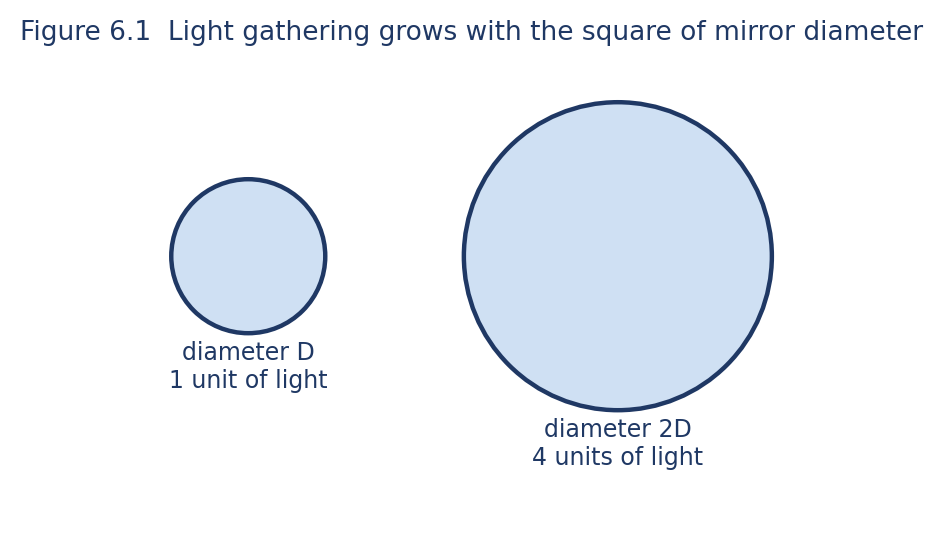
Worked example: doubling the mirror. A mirror twice the diameter of another gathers four times as much light, because two squared is four. A mirror ten times the diameter gathers one hundred times as much light. This is why astronomers keep building larger telescopes: a modest increase in diameter brings a large gain in light gathering power, and therefore the ability to see fainter and more distant objects.
6.2 Telescopes Today
Most large modern telescopes use mirrors rather than lenses, because a large mirror is easier to make, support, and keep in shape than a large lens, which can only be held at its edges and sags under its own weight. The largest telescopes today use mirrors many meters across, sometimes built from many smaller segments working together.
Attached instruments then analyze the collected light. A spectrograph, for example, spreads the light into a spectrum so that its lines can be read, turning the telescope into a tool not just for seeing objects but for measuring their temperatures, compositions, and motions. Modern detectors record the light electronically, far more sensitively than the human eye.
6.5 Observations outside Earth’s Atmosphere
The Earth’s atmosphere is both a blessing and an obstacle. It protects us by absorbing much of the ultraviolet, X ray, and gamma ray light from space, but that same absorption blocks those wavelengths from reaching telescopes on the ground. Only certain ranges of wavelengths, chiefly visible light and radio waves, pass freely through the atmosphere to the surface. These clear ranges are called atmospheric windows.
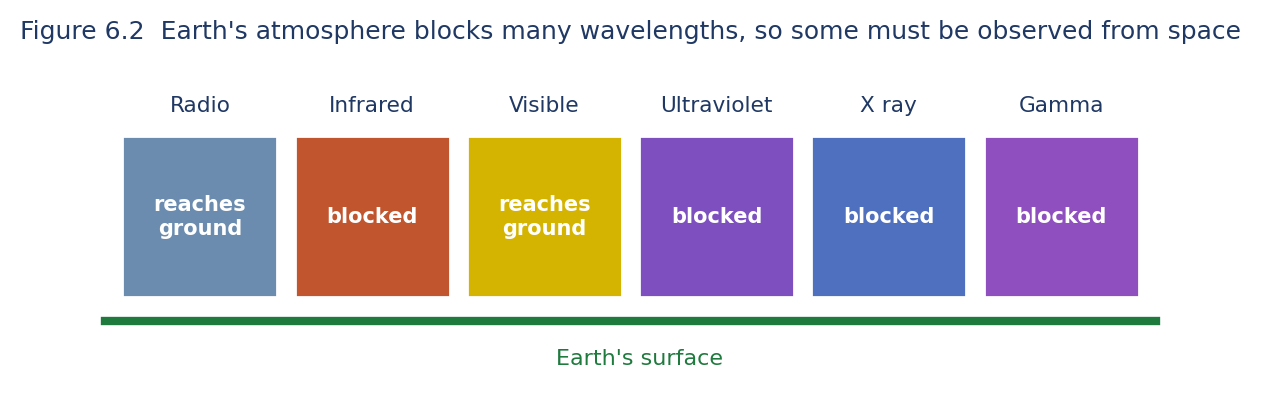
The atmosphere also blurs images, because moving air bends the light and makes stars appear to twinkle. To observe the blocked wavelengths, and to obtain the sharpest possible images, astronomers place telescopes above the atmosphere, in space. Space observatories have transformed astronomy by opening windows the atmosphere keeps closed and by delivering images far sharper than ground based telescopes can normally achieve.
Chapter Summary
A telescope gathers light and reveals detail, using a curved mirror or lens to bring light to a focus, and its light gathering power grows with the square of the mirror diameter, so a mirror twice as wide collects four times as much light. Most large telescopes use mirrors, and instruments such as spectrographs analyze the collected light. Astronomers observe across the whole electromagnetic spectrum, and because the atmosphere blocks some wavelengths, letting only atmospheric windows through, and blurs images, certain observations must be made from space.
Key Terms
Telescope: an instrument that gathers light and brings it to a focus, revealing faint objects and fine detail
Focus: the point where a mirror or lens concentrates the light it gathers
Light gathering power: a telescope’s ability to collect light, growing with the square of the mirror diameter
Spectrograph: an instrument that spreads collected light into a spectrum for analysis
Atmospheric window: a range of wavelengths, chiefly visible light and radio, that can pass through the atmosphere to the ground
Review Questions
1. One telescope has a mirror three times the diameter of another. How much more light does it gather?
Answer: Nine times as much, because light gathering grows with the square of the diameter, and three squared is nine.
2. Why do most large telescopes use mirrors rather than lenses?
Answer: A large mirror is easier to make, support, and keep in shape, while a large lens can only be held at its edges and sags under its own weight.
3. Why are ultraviolet and X ray telescopes placed in space?
Answer: Because the Earth’s atmosphere absorbs those wavelengths, so they cannot be observed from the ground.
Chapter 7. Other Worlds: An Introduction to the Solar System
Adapted from OpenStax Astronomy 2e (CC BY-NC-SA 4.0). Complementary notes provided free of charge by E2 Innovations LLC for Virginia Research Institute.
Pairs with Lecture 3, An Introduction to the Solar System
Learning Objectives
After completing this chapter, you should be able to:
Describe the overall layout of the solar system and the evidence for a shared origin.
Distinguish the terrestrial planets from the giant planets.
Explain how the number of craters on a surface indicates its age.
Summarize how the solar system formed.
Before studying the planets one by one, it helps to see the solar system as a whole. This chapter describes the layout of the system, the two broad families of planets, how we read the age of a surface, and how the whole system came to be.
7.1 Overview of Our Planetary System
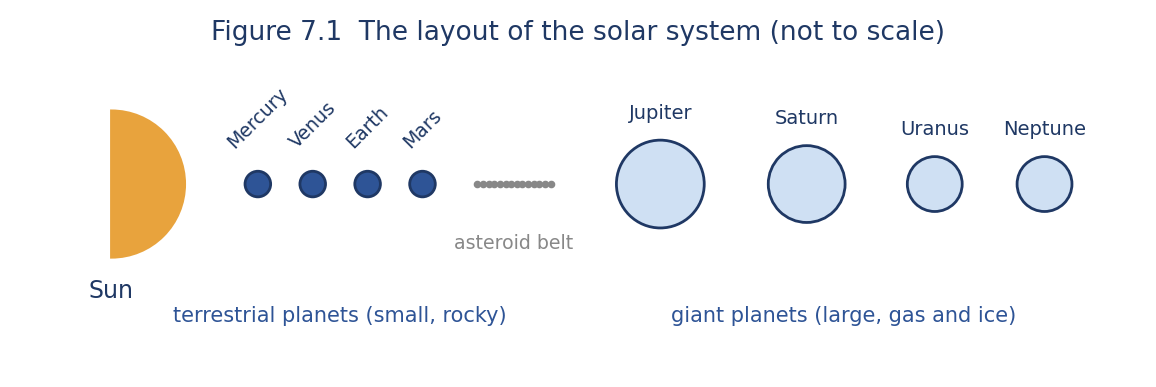
At the center of the solar system sits the Sun, which holds nearly all of the system’s mass, so much that everything else, all the planets and moons and smaller bodies combined, makes up only a tiny fraction. Around the Sun orbit eight planets, along with dwarf planets, moons, asteroids, and comets. The planets all orbit in nearly the same plane and in the same direction, a pattern that points strongly to a shared origin from a single spinning disk of gas and dust.
The system is orderly in its arrangement. The inner region holds small, rocky worlds; a belt of asteroids marks a boundary; and the outer region holds large planets made largely of gas and ice, each surrounded by rings and many moons. Farther out still lies a broad zone of icy bodies. This orderly structure is one of the main clues to how the system formed.
The history of a solid surface is written in its craters. Because impacts have occurred throughout the history of the solar system at a roughly known rate, the number of craters on a surface measures its age: a heavily cratered surface is old and little changed, while a surface with few craters has been resurfaced more recently by geological activity. Crater counting lets astronomers date surfaces on worlds they have never visited.
7.2 Composition and Structure of Planets
The planets divide naturally into two families. The terrestrial planets, Mercury, Venus, Earth, and Mars, are small, dense, and rocky, with solid surfaces and thin or modest atmospheres. The giant planets, Jupiter, Saturn, Uranus, and Neptune, are far larger, much less dense, and composed mostly of gas and ice, with deep atmospheres and no solid surface to stand on.
This sharp division in size, density, and composition is not an accident. It reflects conditions in the disk from which the planets formed, warmer and able to condense only rock and metal near the Sun, colder and rich in ices farther out. The two families are therefore a record of the temperatures at which they were born.
7.4 Origin of the Solar System
The orderly layout of the solar system, together with the ages and compositions of its bodies, supports a clear picture of its origin. The solar system formed from a giant, slowly spinning cloud of gas and dust that collapsed under its own gravity. As it collapsed it spun faster and flattened into a disk, much as a spinning ball of pizza dough flattens into a disk.
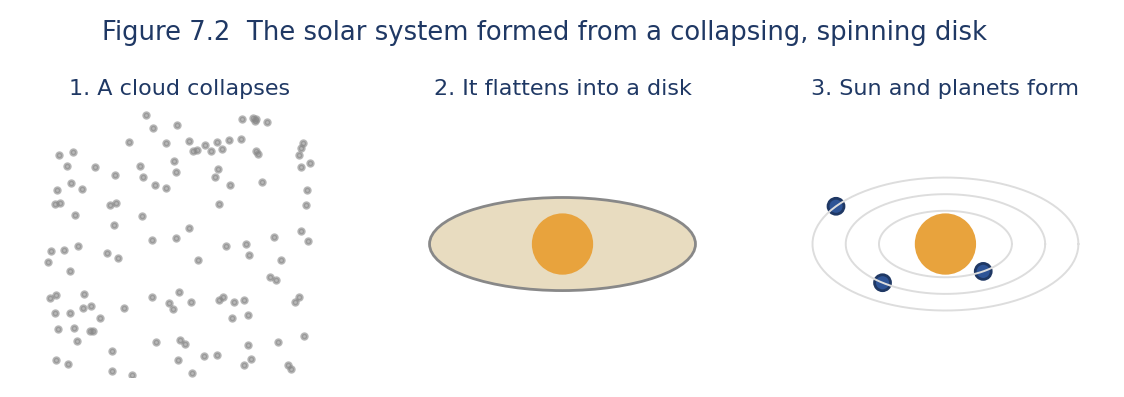
The Sun formed at the dense center of this disk, and the planets grew from material in the surrounding disk, as dust grains stuck together and gradually built up into larger and larger bodies. Because the inner disk was hot, only rock and metal could condense there, forming the terrestrial planets, while the cold outer disk allowed ices and gases to gather into the giant planets. The same process, seen now around other stars, appears to be the general way planetary systems are born.
Chapter Summary
The solar system is orderly, with the Sun holding almost all the mass and the planets orbiting in nearly one plane and direction, a sign of a shared origin. The planets fall into two families, the small rocky terrestrial worlds near the Sun and the large gas and ice giants farther out, a division set by the temperature of the disk where they formed. The number of craters on a surface measures its age. The whole system formed from a collapsing, spinning cloud of gas and dust that flattened into a disk, with the Sun at the center and rocky planets near the warm Sun and giant planets in the cold outer regions.
Key Terms
Terrestrial planet: a small, dense, rocky planet with a solid surface, such as Mercury, Venus, Earth, or Mars
Giant planet: a large, low density planet made mostly of gas and ice, such as Jupiter, Saturn, Uranus, or Neptune
Crater counting: the method of estimating a surface’s age from the number of impact craters on it
Solar nebula: the spinning cloud of gas and dust that collapsed and flattened into a disk to form the Sun and planets
Review Questions
1. What does it suggest that all the planets orbit the Sun in nearly the same plane and direction?
Answer: That they share a common origin, having formed from a single spinning disk of gas and dust.
2. One region of a moon is densely covered in craters and another is smooth with few. Which is older, and why?
Answer: The densely cratered region is older, because more craters mean a longer exposure to impacts, while the smooth region was resurfaced more recently.
3. Why did rocky planets form near the Sun and gas and ice giants form farther out?
Answer: The inner disk was hot, so only rock and metal could condense there, while the cold outer disk allowed ices and gases to gather.
Chapter 8. Earth as a Planet
Adapted from OpenStax Astronomy 2e (CC BY-NC-SA 4.0). Complementary notes provided free of charge by E2 Innovations LLC for Virginia Research Institute.
Pairs with Lecture 4, Earth as a Planet
Learning Objectives
After completing this chapter, you should be able to:
Describe the layered structure of the Earth and how its interior drives surface activity.
Explain how the Earth’s magnetic field is generated and why it matters.
Explain how the atmosphere protects and regulates the surface.
Explain how life, chemistry, and climate influence one another on the Earth.
We understand the Earth better than any other planet, and it serves as the standard against which we measure the rest. This chapter examines the structure of the Earth, its protective atmosphere, and the interplay of life, chemistry, and climate that makes it habitable.
8.1 The Global Perspective
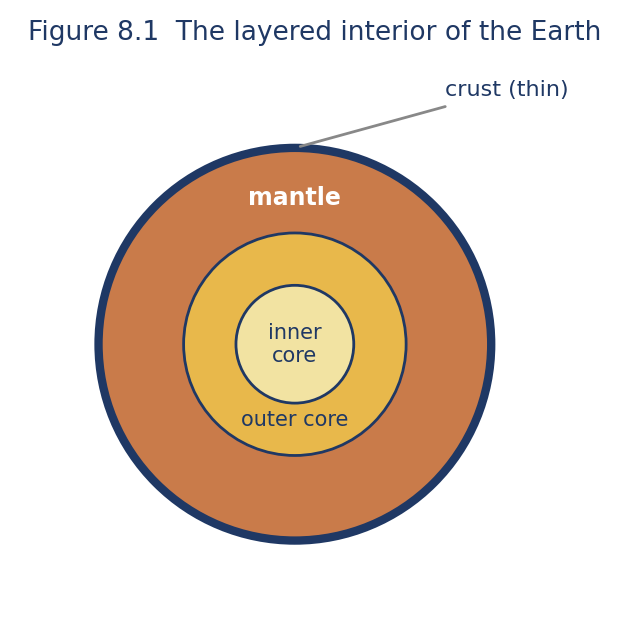
The Earth is divided into layers of different composition and density. At the center is a dense metallic core, part solid and part molten. Surrounding it is a thick rocky mantle, and on the outside is a thin, brittle crust on which we live. The denser materials sank to the center long ago, when the young Earth was hot enough to be partly molten, leaving the lighter rock above.
Heat from the interior drives slow motion in the mantle, which in turn moves the rigid plates of the crust across the surface. Over long spans of time, this plate motion builds mountains, opens and closes oceans, and causes earthquakes and volcanoes, continually reshaping the surface. This is why the Earth, unlike the Moon, has few old craters: its active surface has erased them.
The Earth’s molten metal core also generates a magnetic field that surrounds the planet. This field acts like an invisible shield, deflecting many of the harmful charged particles that stream from the Sun and helping to protect the atmosphere and the surface below.
8.3 Earth’s Atmosphere
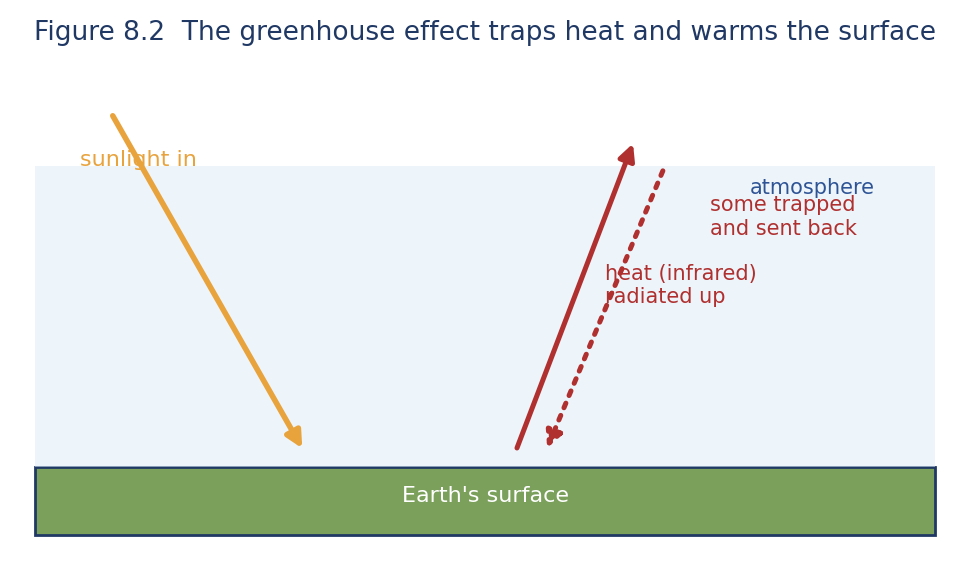
The Earth’s atmosphere is a thin envelope of gas, mostly nitrogen and oxygen, that makes the surface habitable. It provides the air we breathe, shields the surface from much harmful ultraviolet radiation, and traps enough heat to keep the planet warm through the natural greenhouse effect. Without that trapped heat the Earth would be frozen; with too much, it would overheat like Venus.
The atmosphere is also a great engine of weather. Heated unevenly by the Sun, it stirs into winds and storms that carry heat from the warm equator toward the cold poles, and it carries water through the cycle of evaporation and rain that shapes the land and sustains life.
8.4 Life, Chemical Evolution, and Climate Change
The Earth is unique among the planets we know in having abundant liquid water and life, and life has in turn shaped the planet. The oxygen in the atmosphere, for example, did not come from geology but was produced over billions of years by living things through photosynthesis, gradually transforming the air. Life and the planet have evolved together.
Today the balance of gases that controls the greenhouse effect, and therefore the climate, is sensitive to change, and human activity that adds greenhouse gases is altering that balance and warming the planet. Studying the Earth as a planet, alongside its neighbors Venus and Mars, shows both how special its conditions are and how delicately they are maintained.
Chapter Summary
The Earth has a layered interior, a dense metallic core, a thick rocky mantle, and a thin crust, whose heat drives plate motion that continually reshapes the surface and erases old craters, while the molten core generates a protective magnetic field that deflects harmful solar particles. Its thin atmosphere of nitrogen and oxygen provides breathable air, shields the surface from ultraviolet radiation, traps heat through the natural greenhouse effect, and drives weather. Life and climate shape each other on the Earth, the atmospheric oxygen having been produced by living things, and the balance that keeps the planet habitable is sensitive to change.
Key Terms
Core: the dense metallic center of the Earth, part solid and part molten, which generates the magnetic field
Mantle: the thick rocky layer beneath the crust, whose slow motion moves the plates
Crust: the thin, brittle outer layer of the Earth on which we live
Magnetic field: the field generated by the Earth’s molten metal core, shielding the planet from solar particles
Greenhouse effect: the trapping of heat by atmospheric gases, which keeps the surface warm
Review Questions
1. What generates the Earth’s magnetic field, and why does it matter?
Answer: Motion within the Earth’s molten metal core generates it, and it shields the planet by deflecting harmful charged particles from the Sun.
2. Why does the Earth have far fewer old craters than the Moon?
Answer: The Earth’s active surface, driven by plate motion, weather, and water, has erased them over time.
3. Where did the oxygen in the Earth’s atmosphere come from?
Answer: It was produced over billions of years by living things through photosynthesis.
Module 3Comparative Planetology from the Cratered Worlds to the Rings of the Giants
This module tours the planets and their moons using comparative planetology: we understand each world better by comparing it with the others, and above all with the Earth. It contains four chapters, and each chapter pairs with one of the module lectures, covering the same ideas and examples.
Chapter 9. Cratered Worlds
Adapted from OpenStax Astronomy 2e (CC BY-NC-SA 4.0). Complementary notes provided free of charge by E2 Innovations LLC for Virginia Research Institute.
Pairs with Lecture 1, Cratered Worlds (the Moon and Mercury)
Learning Objectives
After completing this chapter, you should be able to:
Describe the main properties of the Moon and why its surface changes so slowly.
Distinguish the lunar highlands from the maria and explain their relative ages.
Explain how an impact crater forms and how crater counts reveal a surface’s age.
Summarize the leading idea for the origin of the Moon.
Compare Mercury with the Moon and identify its distinctive features.
The Moon and Mercury are airless, heavily cratered worlds whose surfaces have changed little in billions of years, which makes them time capsules of the early solar system. Because nothing has erased their ancient scars, they preserve a record that active worlds like the Earth have long since lost. This chapter examines what the Moon’s surface reveals, how impact craters form and are used to measure age, how the Moon may have formed, and how Mercury compares.
9.1 General Properties of the Moon
The Moon is the Earth’s only natural satellite and, at about one quarter of the Earth’s diameter, it is large compared with its planet. It has no atmosphere to speak of and no liquid water, so there is no wind, rain, or flowing water to wear down its surface. As a result, features remain almost unchanged for enormous spans of time, and the footprints left by astronauts will survive for millions of years. Its surface gravity is only about one sixth of the Earth’s, which is why the astronauts who walked there could bound across the ground.
Without an atmosphere to moderate temperatures, the Moon swings between great heat in the long lunar day and deep cold in the long lunar night. Its surface is covered by a layer of broken rock and fine dust, called the regolith, produced by countless impacts grinding up the surface over billions of years. This quiet, ancient world preserves a record of the early solar system that geological activity on the Earth has erased.
9.2 The Lunar Surface
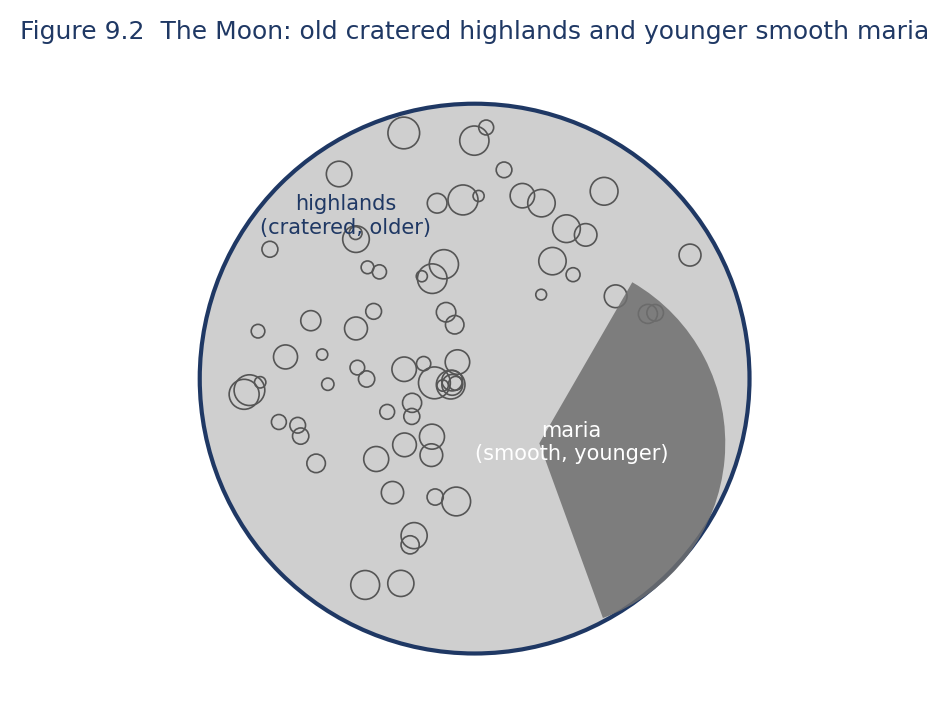
The Moon has two main terrains, easily told apart even with the naked eye. The bright, rugged highlands are heavily cratered and very old, dating back more than four billion years to the era of heavy bombardment early in the solar system. The darker, smoother plains, called maria, from the Latin word for seas, are younger surfaces that were flooded by lava that welled up and covered the older cratered ground. Because the lava erased the earlier craters, the maria carry far fewer of them.
The contrast between the two terrains is a direct visual record of different surface ages: the crowded highlands are old, and the sparsely cratered maria are younger. This is the key to reading not only the Moon but solid surfaces throughout the solar system.
9.3 Impact Craters
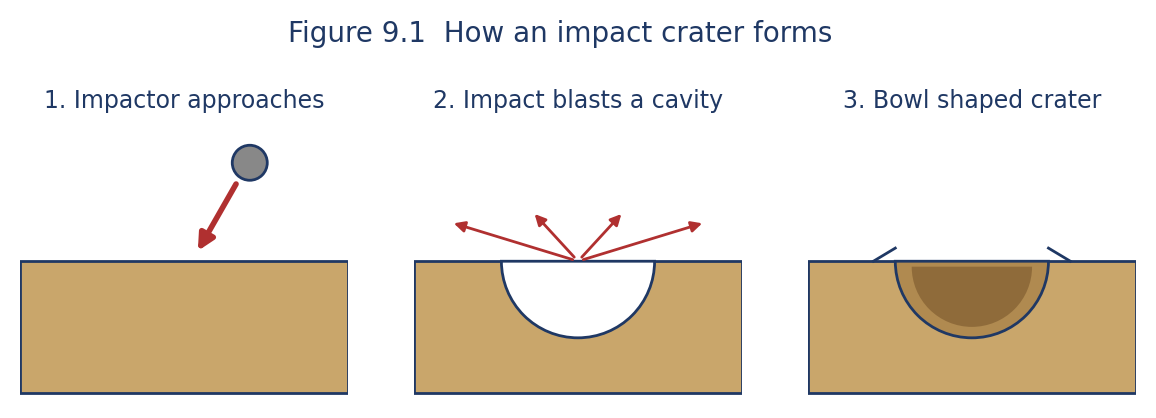
A crater forms when an object such as an asteroid or comet fragment strikes a surface at high speed. The impact releases an enormous burst of energy that blasts out a bowl shaped cavity, throws surrounding material outward as ejecta, and leaves a raised rim around the hole. Larger impacts can produce central peaks and bright streaks of ejected material, called rays, that reach far across the surface.
Because impacts have occurred throughout the history of the solar system at a rate astronomers can estimate, the number of craters on a surface measures its age. A heavily cratered surface has been exposed to impacts for a very long time and is old, while a surface with few craters has been resurfaced more recently, erasing the older craters. Crater counting is the main way astronomers date surfaces on worlds they have never visited.
9.4 The Origin of the Moon
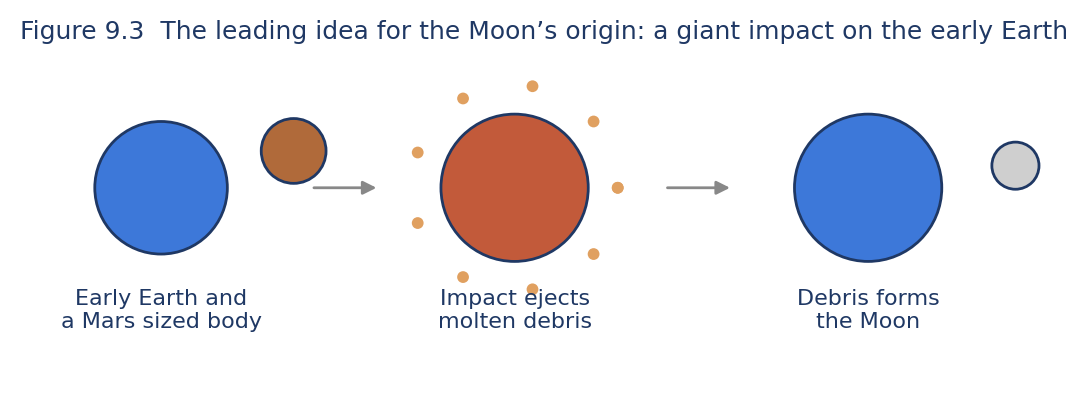
How did the Earth come to have so large a companion? The leading explanation is the giant impact idea. Early in the history of the solar system, a body about the size of Mars is thought to have struck the young Earth a glancing blow. The collision flung a great deal of molten and vaporized material into orbit around the Earth, and that debris gradually gathered together to form the Moon. This idea accounts for several facts, including the Moon’s size and the similarity between the rocks of the Moon and those of the outer Earth.
9.5 Mercury
Mercury, the closest planet to the Sun and the smallest of the eight planets, looks much like the Moon at first glance: airless and heavily cratered. But it differs in important ways. It is far denser than the Moon, with a very large metal core that takes up much of its interior. With almost no atmosphere to store or move heat, Mercury has an extreme temperature range, scorching on its sunlit side and frigid on its night side.
Despite the heat, Mercury has regions of permanent shadow near its poles, in the floors of craters the sunlight never reaches, where ice can survive. The planet is also marked by long cliffs, called scarps, that formed as the whole planet cooled and shrank slightly, wrinkling its crust. Comparing Mercury and the Moon shows how two similar looking worlds can still record very different histories.
Chapter Summary
The Moon is an airless world about a quarter of the Earth’s diameter, with no liquid water and low gravity, so its surface changes only through the slow accumulation of impacts and preserves a record of the early solar system. Its bright, heavily cratered highlands are old, while its darker, smoother maria are younger surfaces flooded by lava. Impact craters form when objects strike at high speed, and the number of craters measures a surface’s age. The Moon is thought to have formed from debris flung into orbit when a Mars sized body struck the early Earth. Mercury resembles the Moon but is much denser, with a large metal core, extreme temperatures, polar ice, and long cliffs from cooling.
Key Terms
Regolith: the layer of broken rock and fine dust covering the Moon, produced by countless impacts
Highlands: the bright, heavily cratered, ancient terrain of the Moon
Maria: the dark, smooth lunar plains, younger surfaces flooded long ago by lava
Impact crater: a bowl shaped depression, with a raised rim and ejecta, formed by a high speed impact
Giant impact idea: the leading explanation that the Moon formed from debris after a Mars sized body struck the early Earth
Scarp: a long cliff on Mercury formed as the planet cooled and shrank
Review Questions
1. Why does the Moon’s surface change so slowly?
Answer: It has no atmosphere or liquid water, so there is no wind, rain, or flowing water to erode it; only slow impacts alter it.
2. A region of the Moon is crowded with craters, while another is smooth. Which is older, and why?
Answer: The crowded region is older, because more craters mean a longer exposure to impacts, while the smooth region was resurfaced by lava.
3. According to the leading idea, how did the Moon form?
Answer: A Mars sized body struck the early Earth, flinging debris into orbit that gathered to form the Moon.
4. Name two ways Mercury differs from the Moon despite their similar cratered appearance.
Answer: Mercury is much denser, with a large metal core, and it has polar ice in permanently shadowed craters and long cliffs from cooling.
Chapter 10. Earthlike Planets: Venus and Mars
Adapted from OpenStax Astronomy 2e (CC BY-NC-SA 4.0). Complementary notes provided free of charge by E2 Innovations LLC for Virginia Research Institute.
Pairs with Lecture 2, Earthlike Planets (Venus and Mars)
Learning Objectives
After completing this chapter, you should be able to:
Describe the basic properties of Venus and Mars and how each was explored.
Explain the runaway greenhouse effect that made Venus so hot.
Describe the evidence that Mars was once warmer and wetter.
Explain the idea of divergent evolution among Venus, Earth, and Mars.
Venus and Mars are the Earth’s nearest planetary neighbors, and both were once imagined as possible twins of the Earth. Yet spacecraft have revealed them to be strikingly different from the Earth and from each other. This chapter examines the two worlds, the runaway greenhouse of Venus, the cold and once wetter Mars, and the lesson of divergent evolution.
10.1 The Nearest Planets: An Overview
Venus is almost exactly the Earth’s size, while Mars is smaller, about half the Earth’s diameter. Venus is perpetually hidden beneath thick clouds, so its surface was mapped not with ordinary cameras but with radar that can see through the clouds. It also rotates very slowly and in the opposite direction to most planets. Mars, by contrast, has a thin, clear atmosphere, two tiny moons, and polar ice caps, and it experiences seasons much as the Earth does because its axis is tilted by a similar amount.
Both worlds have been visited by many spacecraft, including orbiters that map them from above and, in the case of Mars, landers and rovers that study the surface directly. These missions turned Venus and Mars from points of light into detailed worlds and made them a natural laboratory for understanding what shapes a planet’s fate.
10.4 The Geology of Mars
Mars today is a cold desert, but its surface is dramatic. It has the largest volcano known in the solar system, a vast canyon system that would stretch across a continent on the Earth, and polar caps made of frozen water and frozen carbon dioxide. Great dust storms sometimes spread across the whole planet. Most tellingly, the surface is carved with dry riverbeds, ancient lake basins, and minerals that form only in the presence of water.
This evidence is strong that liquid water once flowed on Mars and that its early climate was warmer and wetter than it is now. Over time Mars lost most of its atmosphere and its surface water. Its low gravity let gases escape more easily, and the loss of its protective magnetic field allowed the solar wind to strip the atmosphere away, leaving the frozen desert we see today.
10.5 Water and Life on Mars
Because liquid water is essential to life as we know it, the evidence that Mars once had abundant water makes it a prime target in the search for life beyond the Earth. Robotic landers and rovers have searched for signs of past or present life and have confirmed that conditions long ago could have been suitable for it. Water still exists on Mars today as ice, at the poles and beneath the surface. No life has been found, but the question remains open and is one of the main reasons Mars is explored so intensively.
10.6 Divergent Planetary Evolution
Venus took the opposite path from Mars. It is wrapped in a massive atmosphere of carbon dioxide far denser than the Earth’s, which traps heat so effectively that the surface is hot enough to melt lead, hotter even than Mercury, despite Venus being farther from the Sun. This is a runaway greenhouse effect: early warming drove more gas into the atmosphere, which trapped still more heat, in a cycle that left the planet permanently overheated and dried out.
Three worlds, Venus, Earth, and Mars, began as rocky planets in the same region of the solar system, formed from similar materials, yet followed very different paths. Venus overheated, Mars froze and dried, and only the Earth kept the moderate temperatures and liquid water that life needs. This pattern is called divergent evolution, and its causes trace to differences in distance from the Sun, planet size, and how each atmosphere evolved. Understanding it is not just planetary history; it sharpens our understanding of what keeps the Earth habitable and how delicate that balance is.
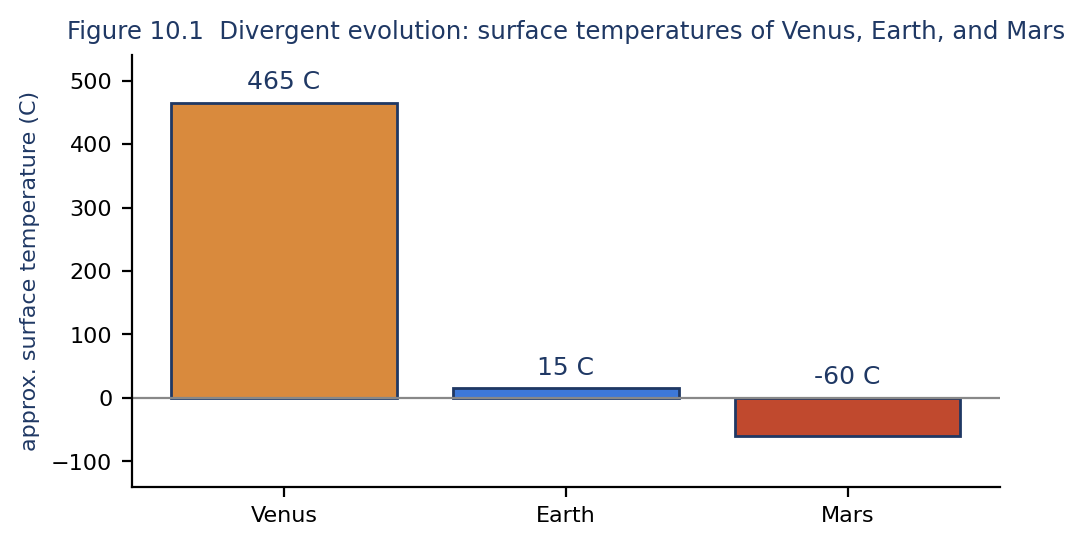
A common misconception. It may seem surprising that Venus is hotter than Mercury even though it is farther from the Sun. The reason is not distance but atmosphere: Mercury has almost none, so its heat escapes to space, while Venus’s thick carbon dioxide blanket traps heat through the greenhouse effect.
Chapter Summary
Venus is nearly the Earth’s size but hidden beneath thick clouds and mapped by radar, while Mars is about half the Earth’s size, with a thin atmosphere, polar caps, and seasons. Mars is a cold desert today, but its huge volcanoes, canyons, dry riverbeds, and water formed minerals show it was once warmer and wetter, which makes it a target in the search for life. Venus suffered a runaway greenhouse effect that makes it the hottest planet, hotter even than Mercury, because of its thick carbon dioxide atmosphere. Venus, Earth, and Mars began alike but evolved very differently, and understanding this divergent evolution illuminates what keeps the Earth habitable.
Key Terms
Runaway greenhouse effect: a self reinforcing warming that left Venus with a thick atmosphere and a scorching surface
Divergent evolution: the process by which Venus, Earth, and Mars began alike but developed very differently
Radar mapping: the technique used to map the surface of cloud covered Venus by bouncing radio waves off it
Solar wind: the stream of particles from the Sun that helped strip away much of the martian atmosphere
Review Questions
1. Why is the surface of Venus so hot, hotter even than Mercury?
Answer: Its thick carbon dioxide atmosphere traps heat in a runaway greenhouse effect, while Mercury has almost no atmosphere to trap heat.
2. What is the main evidence that Mars once had liquid water?
Answer: Dry riverbeds, ancient lake basins, and minerals that form only in the presence of water.
3. How did Mars lose most of its atmosphere?
Answer: Its low gravity let gases escape, and the loss of its magnetic field let the solar wind strip the atmosphere away.
4. What does divergent evolution mean for Venus, Earth, and Mars?
Answer: They began as similar rocky worlds but followed very different paths, ending as a furnace, a habitable world, and a frozen desert.
Chapter 11. The Giant Planets
Adapted from OpenStax Astronomy 2e (CC BY-NC-SA 4.0). Complementary notes provided free of charge by E2 Innovations LLC for Virginia Research Institute.
Pairs with Lecture 3, The Giant Planets
Learning Objectives
After completing this chapter, you should be able to:
Explain how spacecraft have allowed the study of the outer planets.
Describe the composition and structure of the giant planets.
Compare the four giant planets with one another and with the Earth.
Describe the deep, stormy atmospheres of the giant planets.
Beyond Mars lie the giants, Jupiter, Saturn, Uranus, and Neptune, worlds so large and so different from the Earth that they follow their own rules. This chapter examines how we explore them, what they are made of, and what their vast atmospheres are like.
11.1 Exploring the Outer Planets
The giant planets are so distant that they remained little more than points of light in telescopes until spacecraft flew out to meet them. The two Voyager spacecraft flew past all four giants, sending back the first close images, and later missions orbited Jupiter and Saturn for years, studying them and their moons in detail. These missions transformed the giants from faint disks into detailed worlds with storms, rings, and swarms of moons.
Almost everything we know in detail about the outer solar system comes from these spacecraft, because no telescope on the Earth can match a close visit. Reaching these planets takes years of travel, and each mission returns a wealth of information that keeps scientists busy long after the spacecraft has moved on.
11.2 The Giant Planets
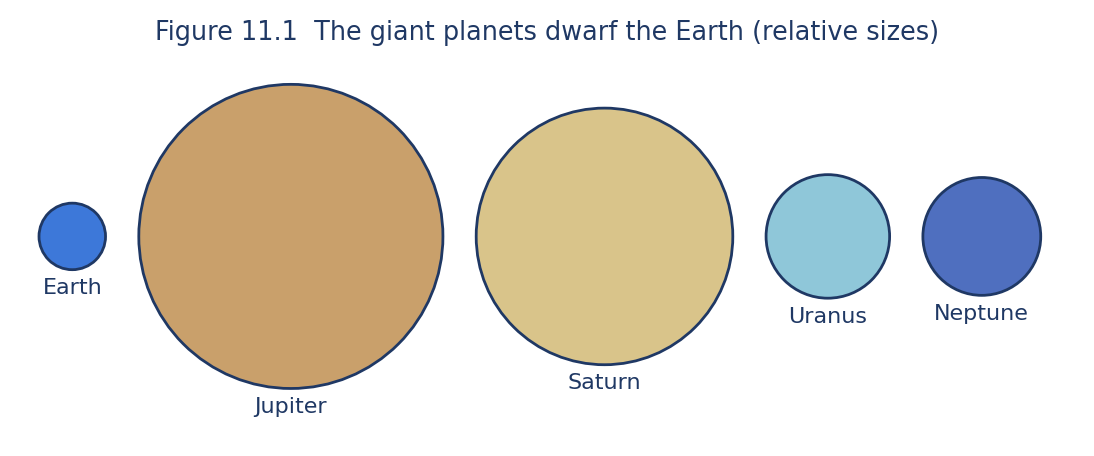
Unlike the small, rocky terrestrial planets, the giants are enormous and composed mostly of light materials. Jupiter, the largest and most massive planet, and Saturn are made largely of hydrogen and helium, the same elements that make up the Sun. Uranus and Neptune are smaller and contain a larger share of water, ammonia, and methane ices, which is why they are sometimes called ice giants. All four dwarf the Earth: Jupiter alone is more massive than all the other planets combined.
None of the giant planets has a solid surface to stand on. Instead, the atmosphere simply grows denser and hotter with depth until it blends smoothly into a fluid interior, perhaps surrounding a small dense core. Their great size, low density, and lack of a surface set them sharply apart from the terrestrial worlds, and they also give off more heat than they receive from the Sun, a sign of energy still escaping from their interiors.
11.3 Atmospheres of the Giant Planets
The atmospheres of the giant planets are vast and turbulent. They are marked by bands of clouds running parallel to the equator, driven by fast winds that can blow faster than any wind on the Earth, and by long lived storms. Jupiter’s Great Red Spot is the most famous, a storm larger than the whole Earth that has raged for centuries.
The colors and patterns of these atmospheres come from the chemistry of their clouds and from heat rising out of the planet’s interior, which stirs the atmosphere from below. Studying this weather teaches us about atmospheric physics under conditions far more extreme than anything on the Earth, and it helps us understand our own planet’s weather by comparison.
Chapter Summary
Spacecraft such as the Voyagers turned the distant giant planets from points of light into detailed worlds, and almost all of our close knowledge of them comes from these missions. Jupiter and Saturn are made mostly of hydrogen and helium, while Uranus and Neptune hold more ices, and all four dwarf the Earth, with Jupiter the largest and most massive. None has a solid surface; the atmosphere blends into a fluid interior, and the planets give off more heat than they receive. Their deep atmospheres are banded and stormy, with features such as Jupiter’s centuries old Great Red Spot.
Key Terms
Giant planet: a large, low density planet made mostly of gas and ice, with no solid surface
Ice giant: a giant planet such as Uranus or Neptune with a large share of water, ammonia, and methane ices
Great Red Spot: a giant, long lived storm on Jupiter, larger than the whole Earth
Cloud bands: the banded cloud patterns of a giant planet, driven by fast winds and internal heat
Review Questions
1. Where does most of our detailed knowledge of the giant planets come from?
Answer: From spacecraft, such as the Voyagers, that flew past or orbited them.
2. What are Jupiter and Saturn made of mostly, and how do Uranus and Neptune differ?
Answer: Jupiter and Saturn are mostly hydrogen and helium; Uranus and Neptune hold a larger share of ices, so they are called ice giants.
3. Why do the giant planets have no solid surface?
Answer: Their atmospheres grow denser with depth and blend into a fluid interior, with no solid ground to stand on.
4. What is Jupiter’s Great Red Spot?
Answer: A giant, long lived storm, larger than the whole Earth, that has persisted for centuries.
Chapter 12. Rings, Moons, and Pluto
Adapted from OpenStax Astronomy 2e (CC BY-NC-SA 4.0). Complementary notes provided free of charge by E2 Innovations LLC for Virginia Research Institute.
Pairs with Lecture 4, Rings, Moons, and Pluto
Learning Objectives
After completing this chapter, you should be able to:
Describe what planetary rings are made of and how they are shaped.
Describe the diversity of the large moons of the giant planets.
Explain why some icy moons are targets in the search for life.
Explain why Pluto is classified as a dwarf planet.
The giant planets are surrounded by systems of rings and moons so varied that each forms a kind of miniature solar system. This chapter examines the nature of rings, the diversity of the large moons, and the place of Pluto in the outer solar system.
12.1 Ring and Moon Systems Introduced
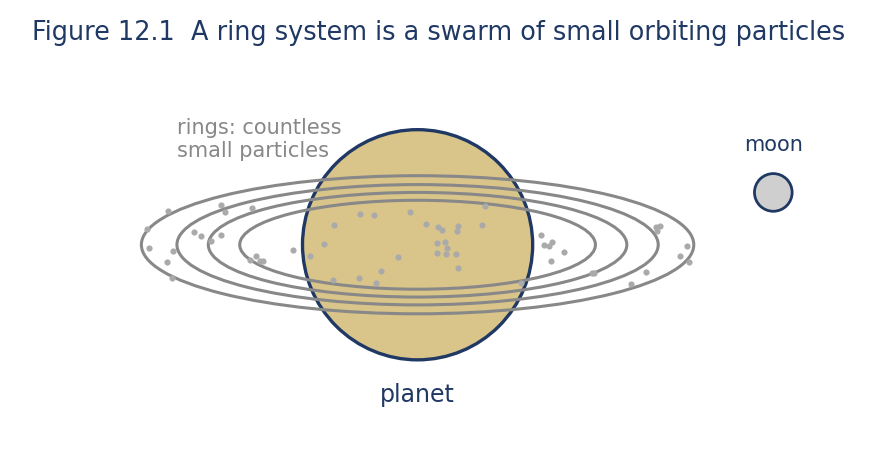
Every giant planet has a ring system, though Saturn’s is by far the most spectacular and the only one easily seen from the Earth. A ring is not a solid disk but a swarm of countless small particles, ranging from dust grains to boulders of ice and rock, each orbiting the planet on its own path. The rings are extraordinarily thin compared with their great width. They may be the debris of a shattered moon, or material that never gathered into a moon, held in a broad flat disk by the planet’s gravity.
12.2 The Galilean Moons of Jupiter
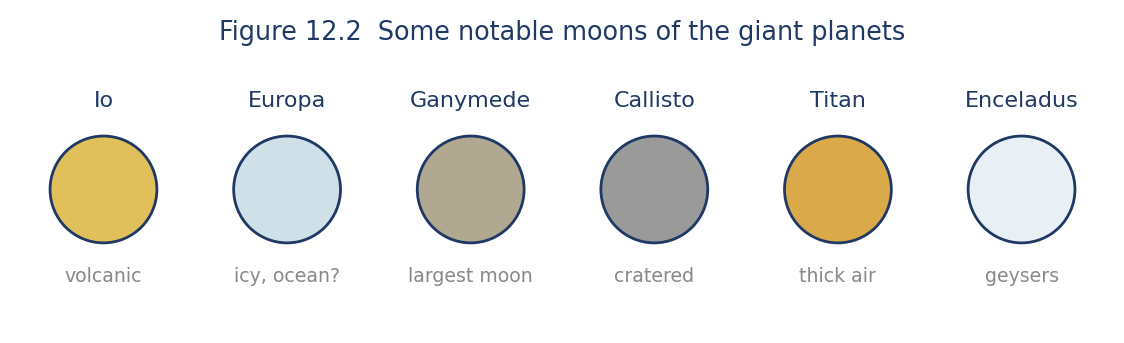
Many moons of the giant planets are as interesting as planets in their own right. Jupiter’s four large moons, discovered by Galileo and named the Galilean moons, are a study in contrasts. Io is the most volcanically active body in the solar system, kept molten by the constant flexing of Jupiter’s gravity. Europa has a smooth icy crust that may hide a liquid water ocean beneath. Ganymede is the largest moon in the solar system, larger even than the planet Mercury, and Callisto is a heavily cratered, ancient world.
Other moons are equally remarkable. Saturn’s Titan has a thick atmosphere and lakes of liquid methane on its surface, and Saturn’s small moon Enceladus sprays geysers of water into space. Several of these icy moons, with their possible subsurface oceans, are among the most promising places to search for life beyond the Earth, which is why they are prime targets for future missions.
12.4 Pluto and Charon
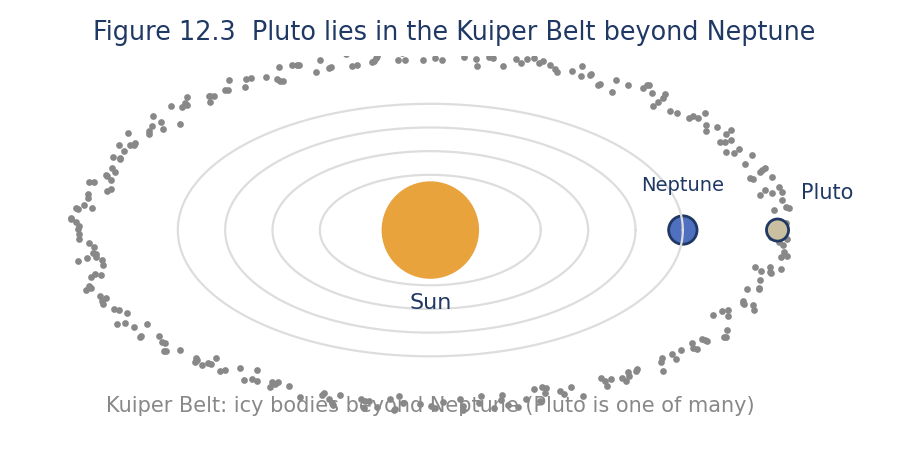
Pluto, once counted as the ninth planet, is now classified as a dwarf planet. It is a small, icy world in the cold region beyond Neptune known as the Kuiper Belt, a broad zone containing many icy bodies. A spacecraft flyby revealed a surprisingly varied surface of nitrogen ice, with mountains and smooth plains, and a thin atmosphere. Pluto has a large moon, Charon, so large relative to Pluto that the two orbit almost as a pair.
Pluto’s reclassification followed the discovery of other similar sized bodies in the same region, which showed that Pluto is one member of a large family rather than a lone planet. It remains a fascinating world, just a different kind of one than the eight planets.
12.5 Planetary Rings (a closer look)
A closer look at rings shows that they are dynamic and finely structured. Small moons, sometimes called shepherd moons, can shape the rings with their gravity, clearing gaps such as the wide division in Saturn’s rings or confining narrow ringlets. Because the particles are constantly orbiting and interacting, ring systems are not permanent, unchanging features but evolving structures, which is part of what makes them so interesting to study.
Chapter Summary
Planetary rings are swarms of countless small particles of ice and rock, not solid disks, held in thin flat disks by the planet’s gravity and shaped by small shepherd moons that clear gaps and confine ringlets. Many large moons are complex worlds, from volcanic Io and icy Europa to giant Ganymede, cratered Callisto, Titan with its methane lakes, and Enceladus with its geysers, and several with possible subsurface oceans are targets in the search for life. Pluto is a dwarf planet in the Kuiper Belt beyond Neptune, one member of a large family of icy bodies, with a varied icy surface and a large moon, Charon.
Key Terms
Ring system: a broad, very thin swarm of small orbiting particles surrounding a giant planet
Galilean moons: the four large moons of Jupiter discovered by Galileo: Io, Europa, Ganymede, and Callisto
Subsurface ocean: a layer of liquid water thought to lie beneath the icy crust of some moons, such as Europa
Dwarf planet: a small, roughly round body, such as Pluto, that is one of many in its region rather than a dominant planet
Kuiper Belt: the broad zone of icy bodies beyond Neptune, of which Pluto is one member
Shepherd moon: a small moon whose gravity shapes a planet’s rings, clearing gaps or confining ringlets
Review Questions
1. What is a planetary ring actually made of?
Answer: Countless small particles of ice and rock, each orbiting the planet on its own path, not a solid disk.
2. Why is Jupiter’s moon Europa of special interest in the search for life?
Answer: Because it may hide a liquid water ocean beneath its icy crust.
3. Which is the largest moon in the solar system, and around which planet does it orbit?
Answer: Ganymede, which orbits Jupiter and is larger even than the planet Mercury.
4. Why is Pluto now classified as a dwarf planet rather than the ninth planet?
Answer: Because it is one of many similar sized icy bodies in the Kuiper Belt beyond Neptune, not a dominant lone planet.
Module 4Comets and Asteroids, Cosmic Samples, and Our Star
This module completes the tour of the solar system with its smallest members, the comets and asteroids that are leftover debris from its birth, then uses those samples to tell the story of how the solar system formed. It closes with the Sun, first as a star we can study in detail and then as the nuclear powerhouse that lights the whole system. It contains four chapters, and each chapter pairs with one of the module lectures.
Chapter 13. Comets and Asteroids: Debris of the Solar System
Adapted from OpenStax Astronomy 2e (CC BY-NC-SA 4.0). Complementary notes provided free of charge by E2 Innovations LLC for Virginia Research Institute.
Pairs with Lecture 1, Comets and Asteroids
Learning Objectives
After completing this chapter, you should be able to:
Describe asteroids and where most of them are found.
Describe the structure of a comet and explain why it grows a coma and tails.
Explain where comets come from and what becomes of them.
Explain how comets and asteroids are leftover debris from the birth of the solar system.
Between and beyond the planets drift countless smaller bodies, the rocky asteroids and the icy comets. They are not merely leftovers to be ignored: because they have changed so little, they are among the best preserved samples of the material from which the planets formed. This chapter examines what they are, how a comet comes to life near the Sun, and where these bodies come from.
13.1 Asteroids
Asteroids are small, rocky and metal bodies left over from the formation of the solar system. Most of them orbit the Sun in the asteroid belt, a broad region between the orbits of Mars and Jupiter. They range from the largest, Ceres, which is round enough to be counted as a dwarf planet, down to countless bodies the size of boulders. Even so, the asteroids are widely scattered, and the total mass of the whole belt is small, far less than that of any planet.
The asteroid belt is not the remains of a shattered planet. Instead, it is material that never managed to gather into a planet, because the strong gravity of nearby Jupiter kept stirring the region and preventing the pieces from combining. Asteroids differ in composition, some being stony and others rich in metal, which tells us about the range of materials present in the early solar system.
13.3 The Long Haired Stars: Comets
Comets are small bodies made of ice and dust, sometimes described as dirty snowballs. Far from the Sun, a comet is simply a dark, frozen lump called the nucleus. But when its orbit brings it close to the Sun, the ices warm and turn to gas, surrounding the nucleus with a glowing cloud called the coma and streaming outward into one or more tails.
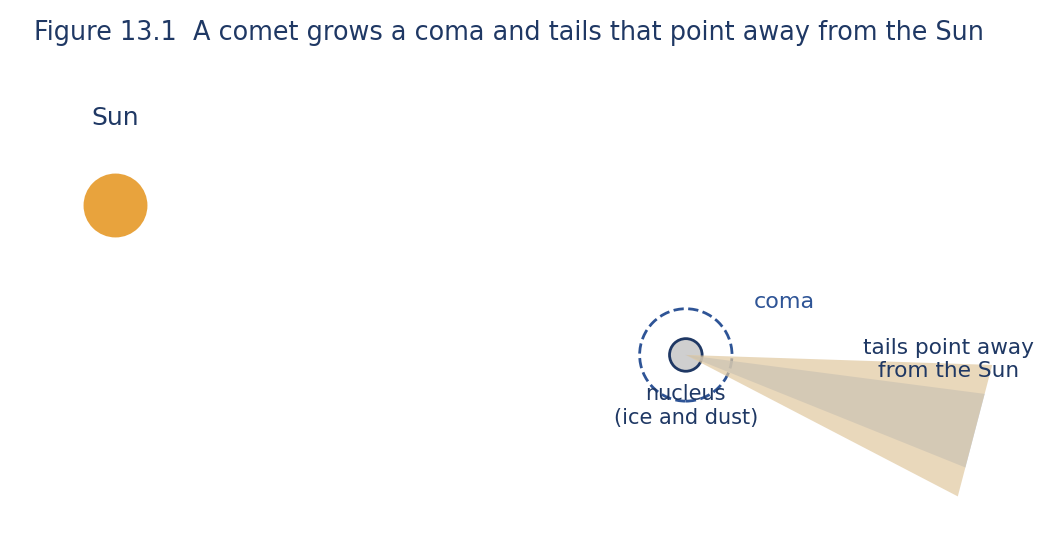
A striking fact is that a comet’s tail always points away from the Sun, no matter which way the comet is moving, because the tail is pushed outward by the radiation and the wind of particles flowing from the Sun. A comet often has two tails, a straight one of gas and a curved one of dust. The long, glowing tail is what made comets appear in the sky as the long haired stars that amazed and sometimes frightened people in the past.
13.4 The Origin and Fate of Comets
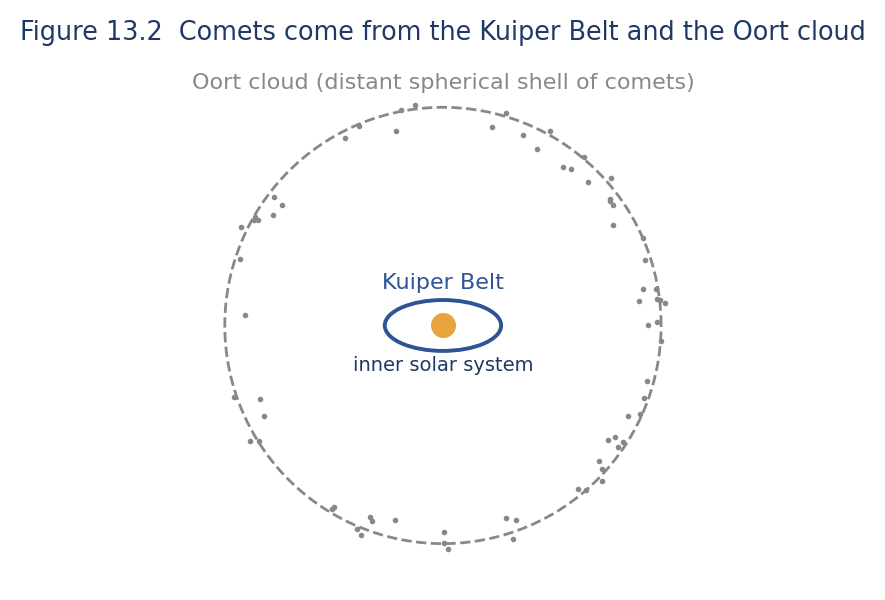
Comets come from the cold outer parts of the solar system, where ices have survived since its birth. There are two great reservoirs. The nearer one is the Kuiper Belt, a flattened region of icy bodies beyond the orbit of Neptune. The more distant one is the Oort cloud, a vast spherical shell of comets surrounding the whole solar system far beyond the planets. Occasionally one of these bodies is nudged onto a path that carries it toward the Sun, and it becomes a comet we can see.
A comet cannot last forever. Each time it passes near the Sun, it loses some of its ice and dust, which is why it grows a tail in the first place. After many passages a comet may break apart or simply lose all its ices, leaving only a dark, rocky remnant. The dust shed along a comet’s path spreads around its orbit, and when the Earth passes through such a trail we see a meteor shower, a topic taken up in the next chapter. Comets and asteroids alike are debris left over from the formation of the solar system, which is what makes them such valuable clues to its history.
Chapter Summary
Asteroids are small rocky and metal bodies, most of them in the belt between Mars and Jupiter, that never gathered into a planet because of Jupiter’s gravity. Comets are icy bodies whose nucleus, when it nears the Sun, releases gas and dust that form a glowing coma and tails, and a comet’s tail always points away from the Sun. Comets come from two reservoirs, the Kuiper Belt beyond Neptune and the distant Oort cloud, and they lose material at each passage until they break up or lose their ices. Both comets and asteroids are debris left over from the birth of the solar system.
Key Terms
Asteroid: a small, rocky or metal body left from the formation of the solar system, most found in the asteroid belt
Asteroid belt: the region between Mars and Jupiter where most asteroids orbit
Comet: a small icy body that grows a coma and tails when it nears the Sun
Nucleus: the solid, frozen core of a comet, made of ice and dust
Coma: the glowing cloud of gas and dust surrounding a comet’s nucleus near the Sun
Kuiper Belt: the flattened reservoir of icy bodies beyond Neptune
Oort cloud: the distant, roughly spherical shell of comets surrounding the solar system
Review Questions
1. Where are most asteroids found?
Answer: In the asteroid belt, the region between the orbits of Mars and Jupiter.
2. Why does the asteroid belt exist as scattered debris rather than a single planet?
Answer: The strong gravity of nearby Jupiter kept the material stirred up so it never gathered into a planet.
3. Which way does a comet’s tail point, and why?
Answer: Away from the Sun, because the radiation and particle wind from the Sun push the gas and dust outward.
4. Name the two reservoirs from which comets come.
Answer: The Kuiper Belt beyond Neptune and the distant Oort cloud.
Chapter 14. Cosmic Samples and the Origin of the Solar System
Adapted from OpenStax Astronomy 2e (CC BY-NC-SA 4.0). Complementary notes provided free of charge by E2 Innovations LLC for Virginia Research Institute.
Pairs with Lecture 2, Cosmic Samples and the Origin of the Solar System
Learning Objectives
After completing this chapter, you should be able to:
Distinguish meteoroids, meteors, and meteorites.
Explain what meteorites reveal about the early solar system.
Summarize how the solar system formed from the solar nebula.
Describe exoplanets and how other planetary systems compare with ours.
Some of the debris left over from the birth of the solar system falls to the Earth, giving us actual samples of ancient material to hold and study. This chapter follows those cosmic samples from the sky to the laboratory, uses them to tell the story of how the solar system formed, and then looks outward to planets around other stars.
14.1 Meteors
A small piece of rocky or metal debris orbiting the Sun is called a meteoroid. When such a piece enters the Earth’s atmosphere at high speed, it heats up and glows, burning a bright streak across the sky. That streak of light is a meteor, popularly called a shooting star, even though it is not a star at all. Most meteoroids are small and burn up completely before reaching the ground.
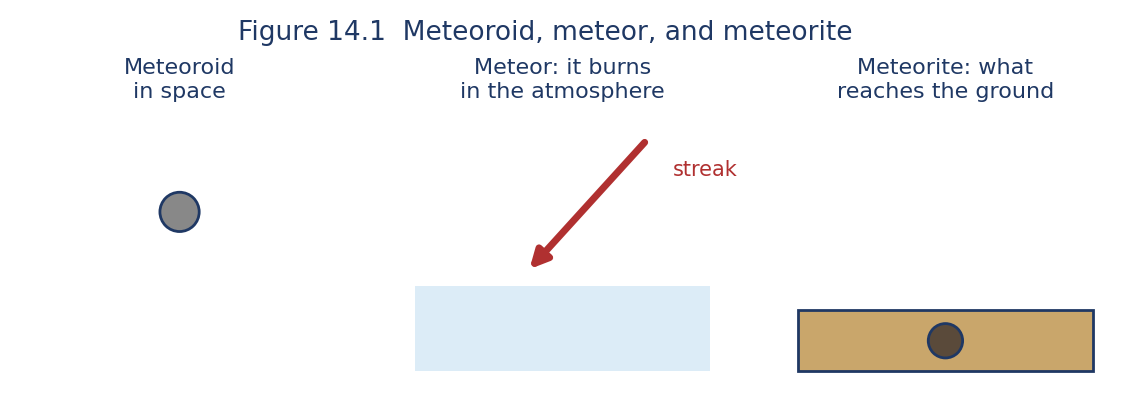
When the Earth passes through the trail of dust left behind by a comet, many meteoroids enter the atmosphere at once, and we see a meteor shower, with dozens of meteors an hour appearing to stream from one part of the sky. Meteor showers recur on the same dates each year, as the Earth returns to the same part of its orbit and crosses the same comet trail.
14.2 Meteorites: Stones from Heaven
A meteoroid large enough to survive its fiery passage and land on the ground is called a meteorite. Meteorites come in stony and metal rich varieties, and they are precious to scientists because many of them are unchanged samples of the early solar system. By measuring them, scientists find that the oldest date back about four and a half billion years, which is taken as the age of the solar system itself. A few rare meteorites have even been identified as pieces knocked off the Moon or Mars.
14.3 Formation of the Solar System
The evidence from meteorites, together with the orderly layout of the planets, supports a clear picture of how the solar system formed, called the solar nebula theory. The system began as a giant cloud of gas and dust that collapsed under its own gravity. As it collapsed it spun faster and flattened into a disk, with the forming Sun at the dense center.
Within the disk, tiny dust grains stuck together and grew into larger and larger bodies, called planetesimals, which then combined to build the planets. Because the inner disk was hot, only rock and metal could condense there, forming the small rocky planets, while the cold outer disk allowed ices and gases to gather into the giant planets. When the young Sun finally began to shine strongly, it blew away the leftover gas, and the debris that remained became the asteroids and comets. This one process accounts for the layout of the planets, their two families, and their common age.
14.4 Comparison with Other Planetary Systems
For most of history we knew of only one planetary system, our own. In recent decades astronomers have discovered thousands of planets around other stars, called exoplanets. One powerful way to find them is the transit method: when a planet passes in front of its star, it blocks a tiny fraction of the light, and the star appears to dim slightly and regularly.
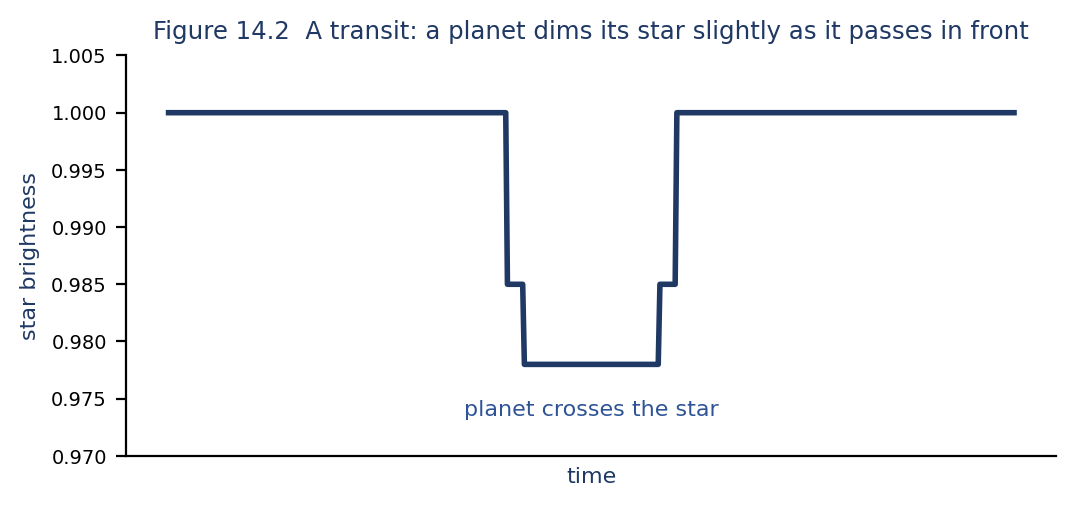
These discoveries show that planets are common, and that other systems can be very different from ours, with giant planets orbiting extremely close to their stars, or planets of sizes we do not have at all. This variety both confirms that the general process of forming planets from a disk is widespread and reminds us that our own solar system is only one of many possible outcomes.
Chapter Summary
A meteoroid is a small piece of space debris; when it burns in the atmosphere it makes a meteor, and if it survives to reach the ground it is a meteorite. Meteor showers occur when the Earth crosses a comet’s dust trail. Meteorites are ancient samples that date the solar system to about four and a half billion years old. The solar system formed from the solar nebula, a collapsing, spinning cloud that flattened into a disk in which dust grew into planetesimals and then planets, with rocky planets near the Sun and giants farther out. Thousands of exoplanets, many found by the transit method, show that planets are common and that other systems can differ greatly from ours.
Key Terms
Meteoroid: a small piece of rocky or metal debris orbiting the Sun
Meteor: the streak of light made when a meteoroid burns up in the atmosphere
Meteorite: a piece of debris that survives its passage and lands on the ground
Planetesimal: a small early body that grew from dust and combined with others to build planets
Solar nebula theory: the explanation that the solar system formed from a collapsing, spinning disk of gas and dust
Exoplanet: a planet orbiting a star other than the Sun
Transit method: finding an exoplanet by the small, regular dimming as it passes in front of its star
Review Questions
1. What is the difference between a meteor and a meteorite?
Answer: A meteor is the streak of light as debris burns in the atmosphere; a meteorite is a piece that survives and lands on the ground.
2. What causes a meteor shower?
Answer: The Earth passing through the trail of dust left behind by a comet, so many meteoroids enter the atmosphere at once.
3. How old is the solar system, and how do we know?
Answer: About four and a half billion years, from measuring the oldest meteorites.
4. How does the transit method detect an exoplanet?
Answer: By the small, regular dimming of a star’s light as the planet passes in front of it.
Chapter 15. The Sun: A Garden Variety Star
Adapted from OpenStax Astronomy 2e (CC BY-NC-SA 4.0). Complementary notes provided free of charge by E2 Innovations LLC for Virginia Research Institute.
Pairs with Lecture 3, The Sun: A Garden Variety Star
Learning Objectives
After completing this chapter, you should be able to:
Describe the composition and layered structure of the Sun.
Identify the layers of the solar atmosphere.
Explain what sunspots are and describe the solar cycle.
Describe forms of solar activity such as prominences and flares.
The Sun is the one star we can study up close, and it turns out to be an ordinary star, a useful example of the billions of others. This chapter examines what the Sun is made of, its layered structure, and the restless magnetic activity that plays across its surface.
15.1 The Structure and Composition of the Sun
The Sun is an enormous ball of hot gas, made mostly of hydrogen and helium, the two lightest and most common elements in the universe. It is not solid and has no surface to stand on. Instead it is arranged in layers. Deep inside is the core, where energy is generated. Surrounding the core are two zones through which that energy travels outward, the radiative zone and, above it, the convective zone, where hot gas rises and cool gas sinks like a boiling pot.
Above the interior lies the part of the Sun we actually see, the photosphere, its bright visible surface, with a temperature of roughly six thousand degrees. Above the photosphere is a thin atmosphere, first the reddish chromosphere and then the faint, hot outer corona, which stretches far into space and is normally visible only during a total solar eclipse.
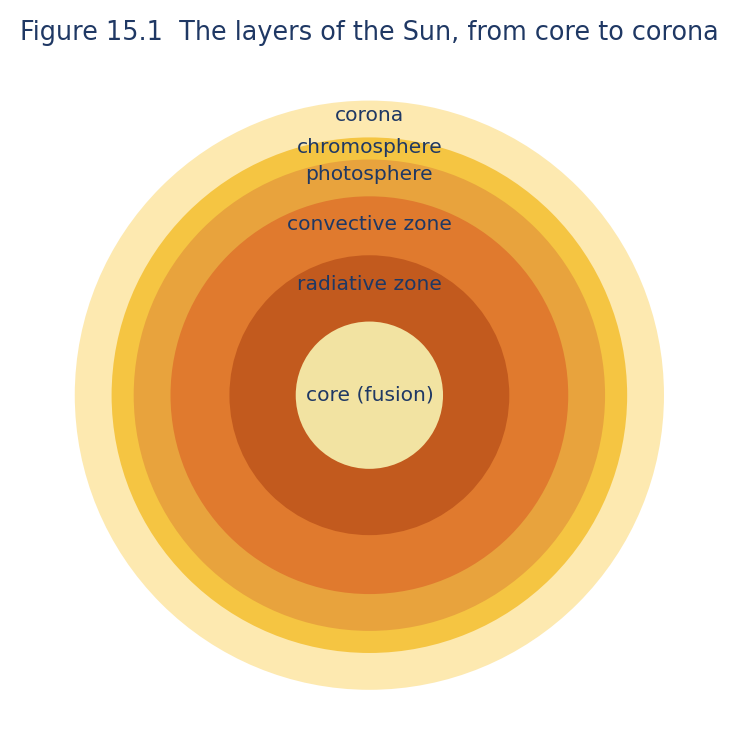
15.2 The Solar Cycle
The photosphere is often marked by sunspots, dark patches that are cooler, and therefore darker, than their surroundings. Sunspots are caused by strong magnetic fields that slow the flow of heat to that part of the surface. The number of sunspots rises and falls in a regular pattern, reaching a maximum and then a minimum about every eleven years, in what is called the solar cycle.
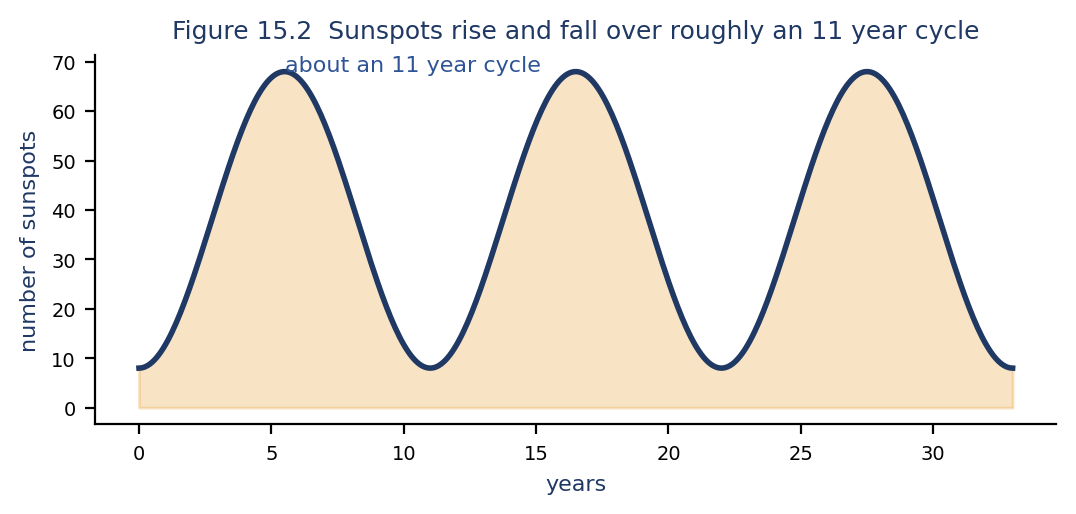
The solar cycle reflects the slow winding up and unwinding of the Sun’s magnetic field. At the peak of the cycle the Sun is covered with many spots and is magnetically very active; at the minimum, spots may be almost absent. This magnetic rhythm governs much of the activity seen on and above the Sun.
15.3 Solar Activity above the Photosphere
Above the photosphere the Sun’s magnetic field drives spectacular activity. Prominences are great arcs of glowing gas that loop high above the surface, suspended by magnetic fields. Solar flares are sudden, violent bursts of energy that release radiation across the spectrum, and related eruptions can hurl huge clouds of particles into space. When such bursts of particles reach the Earth, they can disturb our magnetic field, produce brilliant auroras, and interfere with satellites and communications. This flow of activity from the Sun to the Earth is called space weather, and it links our planet directly to the star it orbits.
Chapter Summary
The Sun is an ordinary star, a ball of hot gas made mostly of hydrogen and helium, with no solid surface. Its layers run from the core, where energy is generated, out through the radiative and convective zones to the visible photosphere, and then to the thin chromosphere and the faint outer corona. Sunspots are cooler, darker magnetic patches whose number rises and falls over an eleven year solar cycle. Above the photosphere, magnetic activity produces prominences, flares, and eruptions of particles that reach the Earth as space weather, disturbing our magnetic field and producing auroras.
Key Terms
Photosphere: the bright visible surface of the Sun, at about six thousand degrees
Corona: the faint, hot outer atmosphere of the Sun, seen during a total eclipse
Sunspot: a cooler, darker patch on the photosphere caused by strong magnetic fields
Solar cycle: the roughly eleven year rise and fall in the number of sunspots and magnetic activity
Prominence: an arc of glowing gas suspended above the Sun by magnetic fields
Solar flare: a sudden, violent burst of energy from the Sun
Space weather: the effects on the Earth of particles and radiation from solar activity
Review Questions
1. What two elements make up most of the Sun?
Answer: Hydrogen and helium.
2. What is a sunspot, and why is it darker than its surroundings?
Answer: A patch of strong magnetic field on the photosphere that is cooler, and therefore darker, than the gas around it.
3. About how long is the solar cycle?
Answer: About eleven years from one sunspot maximum to the next.
4. Name one effect that solar activity can have on the Earth.
Answer: It can disturb the Earth’s magnetic field, produce auroras, or interfere with satellites and communications.
Chapter 16. The Sun: A Nuclear Powerhouse
Adapted from OpenStax Astronomy 2e (CC BY-NC-SA 4.0). Complementary notes provided free of charge by E2 Innovations LLC for Virginia Research Institute.
Pairs with Lecture 4, The Sun: A Nuclear Powerhouse
Learning Objectives
After completing this chapter, you should be able to:
Explain why ordinary burning and gravitational contraction cannot power the Sun.
Explain how nuclear fusion powers the Sun.
State the relationship between mass and energy and apply it in simple terms.
Describe how energy travels from the Sun’s core to its surface.
The Sun has poured out enormous energy for billions of years, and explaining that energy was one of the great puzzles of science. This chapter shows why familiar sources of energy fail, how nuclear fusion solves the puzzle, and how the energy makes its long journey from the core to the surface.
16.1 Sources of Sunshine: Thermal and Gravitational Energy
Whatever powers the Sun must supply a vast amount of energy for an extremely long time. Ordinary burning, like a fire, was quickly ruled out: a Sun made of coal would burn away in only a few thousand years. A cleverer idea was that the Sun shines by slowly contracting under its own gravity, releasing energy as it shrinks. This could last longer, but still only for millions of years, far too short given that rocks and meteorites show the solar system to be billions of years old. Some far more powerful source was needed.
16.2 Mass, Energy, and the Theory of Relativity
The answer came from Einstein’s discovery that mass and energy are two forms of the same thing, related by a famous equation.
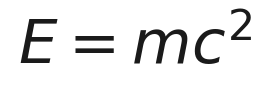
Here E is energy, m is mass, and c is the speed of light. Because the speed of light is enormous, and it is squared in the equation, even a tiny amount of mass can be converted into a huge amount of energy. This is the key to the Sun. In its core, where the temperature and pressure are immense, hydrogen nuclei are forced together and fuse to form helium, a process called nuclear fusion. The helium that results has slightly less mass than the hydrogen that went into it, and that small missing mass is released as energy.
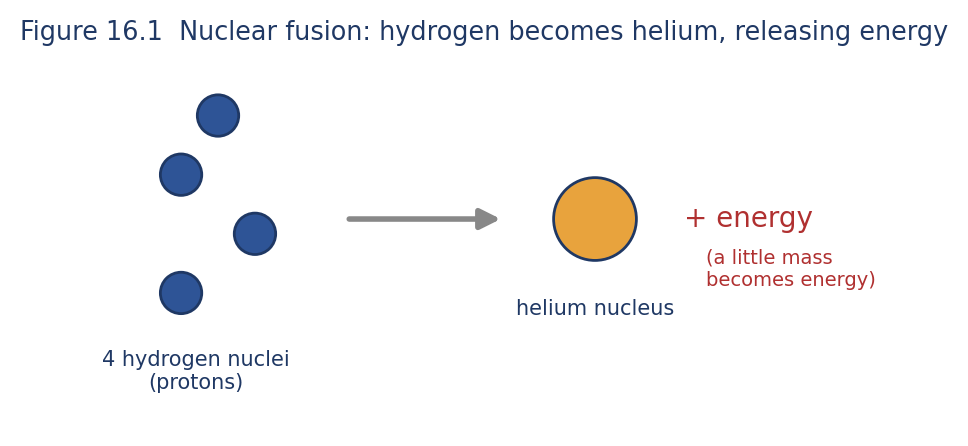
Worked example: a little mass, a lot of energy. Each second, the Sun converts millions of tons of its mass into energy through fusion, yet the Sun is so enormous that it has done this for billions of years and will continue for billions more. The reason so little mass yields so much energy is that in the equation the mass is multiplied by the speed of light squared, an extremely large number.
16.3 The Solar Interior: Theory
Fusion happens only in the Sun’s core, where the conditions are extreme enough. From there the energy must travel outward to escape as sunlight. It first moves through the radiative zone, carried by radiation, and then through the convective zone, carried by rising and sinking currents of hot gas, before finally leaving the photosphere as the light we see.
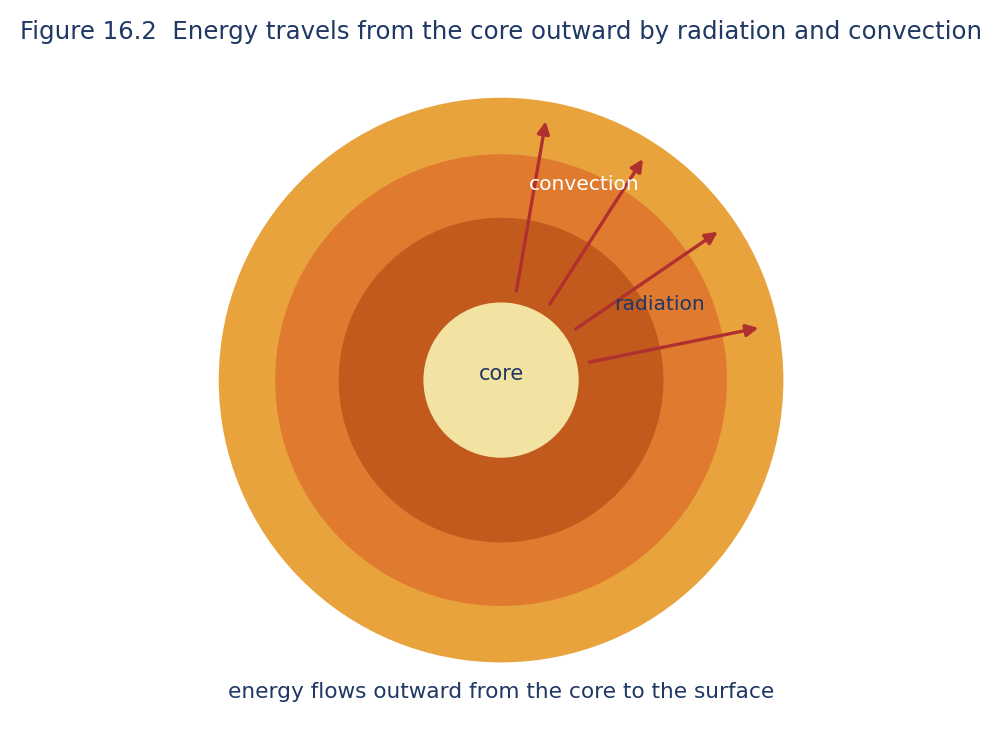
The Sun is stable because it is in balance: the inward pull of gravity is matched by the outward push of pressure from the hot gas and the energy of fusion. This balance has held the Sun steady for billions of years. Astronomers can even test their picture of the hidden core by detecting tiny particles called neutrinos, which stream directly out of the core and confirm that fusion is indeed the source of the Sun’s power.
Chapter Summary
Ordinary burning and gravitational contraction cannot power the Sun for long enough, given that the solar system is billions of years old. The Sun is powered instead by nuclear fusion, in which hydrogen nuclei in the hot, dense core fuse into helium. Because the helium has slightly less mass than the hydrogen, the missing mass is released as energy, following the relationship that energy equals mass times the speed of light squared, so a tiny mass yields enormous energy. The energy travels from the core outward through the radiative and convective zones to the surface, and the Sun stays stable through the balance of gravity pulling in and pressure pushing out.
Key Terms
Nuclear fusion: the joining of light nuclei into heavier ones, releasing energy, which powers the Sun
Mass energy relationship: the principle that energy equals mass times the speed of light squared, so a little mass yields much energy
Radiative zone: the inner layer through which energy travels outward as radiation
Convective zone: the outer interior layer through which energy travels by rising and sinking gas
Neutrino: a tiny particle produced by fusion that streams out of the Sun’s core and confirms it
Review Questions
1. Why can ordinary burning not account for the Sun’s energy?
Answer: A burning Sun would use up its fuel in only a few thousand years, far too short a time.
2. What process powers the Sun, and what does it turn hydrogen into?
Answer: Nuclear fusion, which fuses hydrogen nuclei into helium in the Sun’s core.
3. Why does converting a small amount of mass release so much energy?
Answer: Because energy equals mass times the speed of light squared, and the speed of light squared is an enormous number.
4. How does energy travel from the Sun’s core to its surface?
Answer: Outward through the radiative zone by radiation and then through the convective zone by rising and sinking gas.
Module 5Reading the Light of the Stars, Taking a Census, Measuring Distances, and the Space Between
This module turns from the solar system to the stars. It shows how astronomers read the light of a star to learn its temperature, composition, and motion, how they take a census of the stars and measure their masses, how they measure the enormous distances to the stars, and what fills the space between them. It contains four chapters, and each chapter pairs with one of the module lectures.
Chapter 17. Analyzing Starlight
Adapted from OpenStax Astronomy 2e (CC BY-NC-SA 4.0). Complementary notes provided free of charge by E2 Innovations LLC for Virginia Research Institute.
Pairs with Lecture 1, Analyzing Starlight
Learning Objectives
After completing this chapter, you should be able to:
Distinguish the apparent brightness of a star from its true luminosity.
Explain how the color of a star reveals its temperature.
Describe how stars are classified by their spectra.
Explain what a star’s spectrum reveals about its composition and motion.
A star is so far away that, even in the largest telescope, it is only a point of light. Yet from that point of light astronomers can read a remarkable amount: how hot the star is, what it is made of, and how it is moving. This chapter shows how the light of a star is analyzed to reveal these properties.
17.1 The Brightness of Stars
When we look at the night sky, some stars appear brighter than others. But apparent brightness, how bright a star looks from the Earth, does not by itself tell us how much light the star truly gives off, because a star can look bright either because it is very luminous or simply because it is close. The true output of a star, the total amount of light it radiates, is called its luminosity. A dim looking star may in fact be a brilliant, distant beacon, while a bright looking one may be a modest star nearby. Separating these two ideas, how bright a star looks and how bright it really is, is the first step in understanding the stars.
Astronomers describe apparent brightness with a numbering system called the magnitude scale, a convention inherited from the ancient Greeks in which brighter objects are given smaller numbers. The very brightest stars have magnitudes near zero or even below, while fainter stars have larger positive numbers. To turn an apparent brightness into a luminosity, we must also know the star’s distance, which is why measuring distance, the subject of a later chapter, is so central to the study of the stars.
17.2 Colors of Stars
Stars come in different colors, and color is a direct clue to temperature. As with any hot glowing object, a hotter star shines bluer and a cooler star shines redder. A blue white star may have a surface temperature several times that of the Sun, while a red star is cooler than the Sun. By simply measuring a star’s color, astronomers get an immediate estimate of its surface temperature.
17.3 The Spectra of Stars
A far richer source of information is the star’s spectrum, its light spread out into all its wavelengths and crossed by spectral lines. Based on the patterns of these lines, which depend mainly on temperature, stars are sorted into a sequence of spectral classes, labeled with the letters O, B, A, F, G, K, and M, running from the hottest, bluest stars to the coolest, reddest ones. Our Sun is a G class star, in the middle of the range.
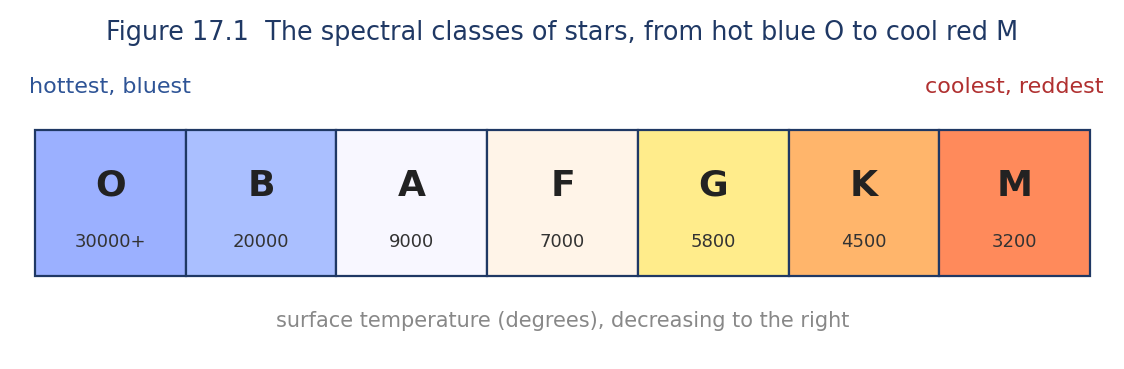
This classification is one of the most useful tools in astronomy, because a star’s spectral class immediately tells us its temperature and much about its nature. Generations of astronomers have used the same lettered sequence to organize the stars.
17.4 Using Spectra to Measure Composition and Motion
Beyond temperature, a spectrum reveals composition and motion. The spectral lines identify which elements are present in the star’s outer layers, and stars turn out to be made mostly of hydrogen and helium, like the Sun. The lines also reveal motion through the Doppler effect: if the whole pattern of lines is shifted toward the red, the star is moving away from us, and if toward the blue, it is approaching. In this way a single spectrum yields a star’s temperature, its composition, and its motion along our line of sight, all from a point of light unimaginably far away.
Chapter Summary
Apparent brightness, how bright a star looks, depends on both its true luminosity and its distance, so a dim looking star may be a distant beacon and a bright looking one a modest nearby star. Color reveals temperature, with hotter stars bluer and cooler stars redder. Stars are classified by their spectra into the sequence O, B, A, F, G, K, and M, from hottest to coolest, and the Sun is a G star. A spectrum also reveals composition, through the spectral lines of the elements present, and motion, through the Doppler shift of those lines.
Key Terms
Apparent brightness: how bright a star looks from the Earth, depending on both its luminosity and its distance
Luminosity: the total amount of light a star truly radiates
Spectral class: the classification of a star by its spectrum, in the sequence O, B, A, F, G, K, M from hottest to coolest
Spectral lines: the pattern of lines in a star’s spectrum that reveal its temperature, composition, and motion
Review Questions
1. Two stars look equally bright in the sky, but one is much farther away. Which has the greater luminosity, and why?
Answer: The farther one, because to look equally bright from a greater distance it must truly radiate more light.
2. A star is distinctly red in color. What does this tell you about its temperature?
Answer: It is relatively cool, cooler than a blue or white star.
3. List the spectral classes from hottest to coolest, and state which class the Sun belongs to.
Answer: O, B, A, F, G, K, M from hottest to coolest; the Sun is a G class star.
Chapter 18. The Stars: A Celestial Census
Adapted from OpenStax Astronomy 2e (CC BY-NC-SA 4.0). Complementary notes provided free of charge by E2 Innovations LLC for Virginia Research Institute.
Pairs with Lecture 2, The Stars: A Celestial Census
Learning Objectives
After completing this chapter, you should be able to:
Describe the range of stars found when we take a census.
Explain how the masses of stars are measured using binary stars.
Describe the Hertzsprung Russell diagram and what it reveals.
Identify the main sequence, giants, supergiants, and white dwarfs.
Having learned to read individual stars, we can now take a census of them, asking what kinds of stars exist, how their masses are measured, and how their properties fit together. The answer is captured in one of the most important diagrams in all of astronomy.
18.1 A Stellar Census
When astronomers survey the stars, they find an enormous range. Some stars are far more massive and luminous than the Sun, and some are far less. But the most common stars by far are small, cool, faint red stars, much less massive than the Sun, while the brilliant, massive stars are rare. The Sun, often thought of as average, is in fact more luminous than most of its neighbors. Taking a fair census means remembering that the showy, luminous stars we notice are the exceptions, not the rule.
This has an important consequence for understanding the galaxy. The faint red stars, although each gives off little light, are so vastly numerous that together they hold a large share of the galaxy’s total stellar mass. The rare luminous stars, by contrast, catch our eye but contribute only a small part of the mass. A true picture of the stellar population, then, looks very different from the one we get by simply noting the brightest stars in the night sky.
18.2 Measuring Stellar Masses
Mass is the single most important property of a star, because it largely determines how the star lives and dies. But mass cannot be read from a single star’s light. Instead, astronomers measure it using binary stars, pairs of stars that orbit each other. By watching how the two stars move around each other and applying Newton’s form of Kepler’s third law, which connects an orbit to the masses involved, astronomers can calculate the masses of the stars. Binary stars are therefore the scale on which the stars are weighed.
18.4 The Hertzsprung Russell Diagram
The properties of the stars fall into a beautiful pattern when luminosity is plotted against temperature. This plot is called the Hertzsprung Russell diagram, after the two astronomers who devised it. On it, most stars, including the Sun, lie along a diagonal band called the main sequence, running from hot, luminous stars at one end to cool, faint stars at the other. These are stars in the long, stable prime of their lives, steadily fusing hydrogen into helium.
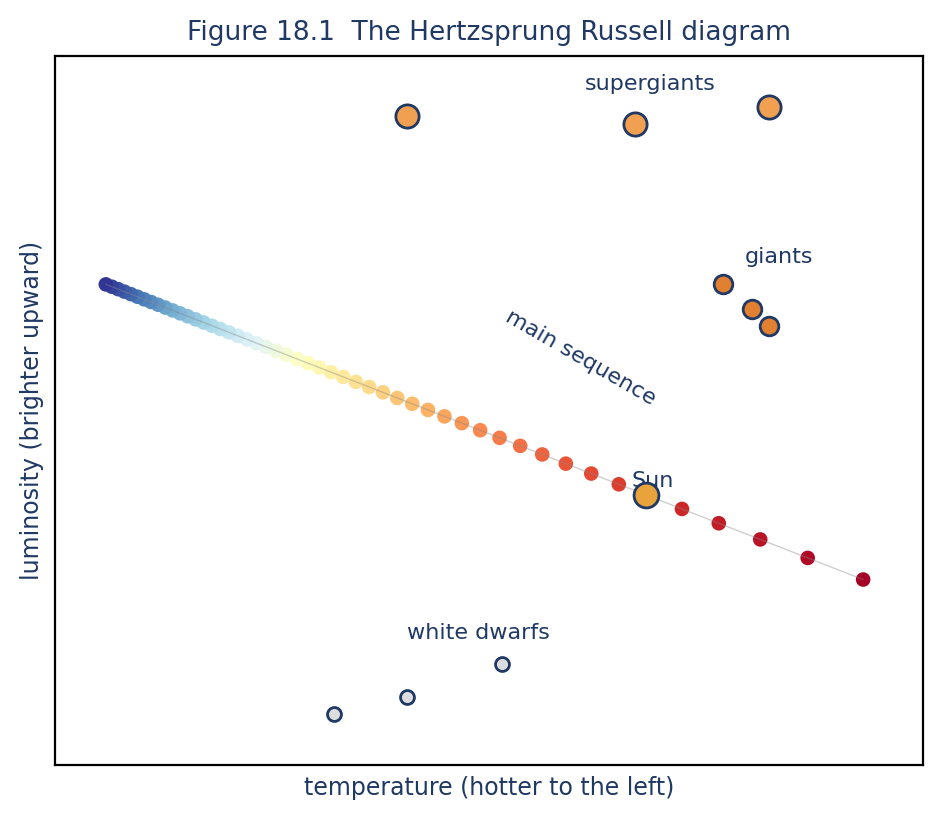
Away from the main sequence lie other groups. In the upper right are the giants and supergiants, stars that are cool but very luminous, because they are enormous. In the lower left are the white dwarfs, stars that are hot but very faint, because they are tiny. The position of a star on this diagram reveals its stage of life, which is why the Hertzsprung Russell diagram is one of the most powerful tools in astronomy.
Along the main sequence itself, a star’s position is set mainly by its mass. The most massive stars sit at the top, hot, blue, and luminous, while the least massive sit at the bottom, cool, red, and faint. Mass also governs how long a star lives, because a massive star burns through its fuel quickly and lives only a short time, whereas a small red star burns slowly and shines steadily for far longer than the present age of the universe. In this way a single diagram ties together a star’s temperature, luminosity, mass, and lifetime.
Chapter Summary
A census of the stars shows a wide range, but the most common stars are small, cool, faint red stars, while massive luminous stars are rare, and the Sun is more luminous than most of its neighbors. Mass, the most important property of a star, is measured using binary stars, whose orbits reveal their masses through Newton’s form of Kepler’s third law. Plotting luminosity against temperature produces the Hertzsprung Russell diagram, on which most stars, including the Sun, lie along the main sequence, with giants and supergiants in the upper right and white dwarfs in the lower left. A star’s position on the diagram reveals its stage of life.
Key Terms
Binary star: a pair of stars orbiting each other, used to measure stellar masses
Hertzsprung Russell diagram: a plot of luminosity against temperature on which stars fall into distinct groups
Main sequence: the diagonal band on the diagram where most stars, including the Sun, spend their stable hydrogen fusing lives
Giant: a cool but very luminous star, large in size, lying in the upper right of the diagram
White dwarf: a hot but very faint star, tiny in size, lying in the lower left of the diagram
Review Questions
1. What is the most common kind of star found in a fair census?
Answer: Small, cool, faint red stars much less massive than the Sun.
2. How do astronomers measure the mass of a star?
Answer: By observing binary stars, pairs orbiting each other, and applying Newton’s form of Kepler’s third law to their orbit.
3. On the Hertzsprung Russell diagram, where do most stars lie, and what are they doing there?
Answer: Along the main sequence, where they spend their stable lives fusing hydrogen into helium.
Chapter 19. Celestial Distances
Adapted from OpenStax Astronomy 2e (CC BY-NC-SA 4.0). Complementary notes provided free of charge by E2 Innovations LLC for Virginia Research Institute.
Pairs with Lecture 3, Celestial Distances
Learning Objectives
After completing this chapter, you should be able to:
Describe the units used to measure astronomical distances.
Explain how parallax is used to measure the distances to nearby stars.
Apply the relationship between parallax and distance.
Explain how variable stars serve as distance markers for far away objects.
Everything we conclude about the stars depends on knowing how far away they are, and distance is the hardest thing in astronomy to measure. This chapter describes the units of cosmic distance and the clever methods, from geometry to special stars, that let astronomers measure across the vast gulfs of space.
19.1 Fundamental Units of Distance
Distances in space are so large that everyday units are useless. Within the solar system, astronomers use the astronomical unit, the average Earth to Sun distance. For the stars, they use the light year, the distance light travels in a year, and a related unit called the parsec, which is about three and a quarter light years. These units let us state the distances to stars in manageable numbers.
No single method can measure every distance in the universe. Nearby stars are measured one way, more distant stars another, and remote galaxies yet another. Astronomers therefore build what is called the distance ladder, a series of methods in which each rung is calibrated using the one below it. The nearest rung, measured by direct geometry, anchors the whole ladder, so an error low down would affect every distance above it. The rest of this chapter describes the first two rungs.
19.2 Surveying the Stars
The most direct way to measure the distance to a nearby star is parallax, a method based on simple geometry. As the Earth orbits the Sun, a nearby star appears to shift back and forth slightly against the more distant background stars, just as a nearby object seems to shift against the far wall when you look at it first with one eye and then the other. The size of this shift depends on the star’s distance: the nearer the star, the larger the shift.
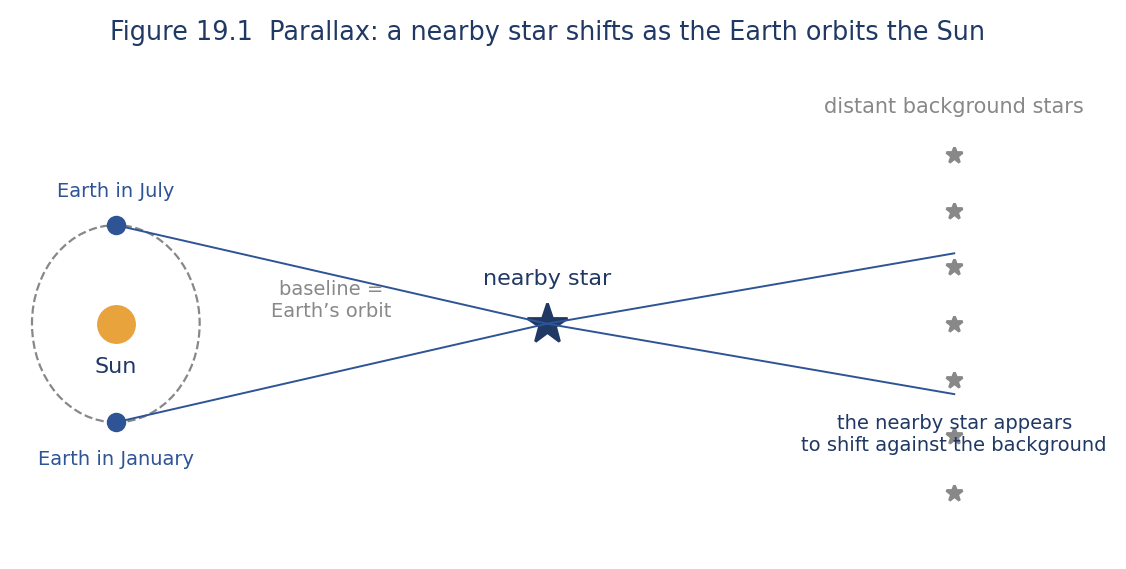
The relationship is beautifully simple. If the parallax angle is measured in units called arcseconds, the distance to the star in parsecs is just one divided by that angle.

Worked example: a nearby star. A star with a parallax of one half of an arcsecond lies at a distance of one divided by one half, which is two parsecs. A smaller parallax means a larger distance, so a star with a parallax of one tenth of an arcsecond is ten parsecs away. Parallax works only for relatively nearby stars, because for distant stars the shift becomes too small to measure.
19.3 Variable Stars: A Key to Cosmic Distances
For stars and galaxies too far away for parallax, astronomers use special stars whose true brightness is known. Certain stars, called Cepheid variables, pulse in brightness in a regular rhythm, and the length of the rhythm reveals the star’s true luminosity: the longer the pulsation period, the more luminous the star. Once its true luminosity is known, comparing it with how bright the star appears gives the distance.
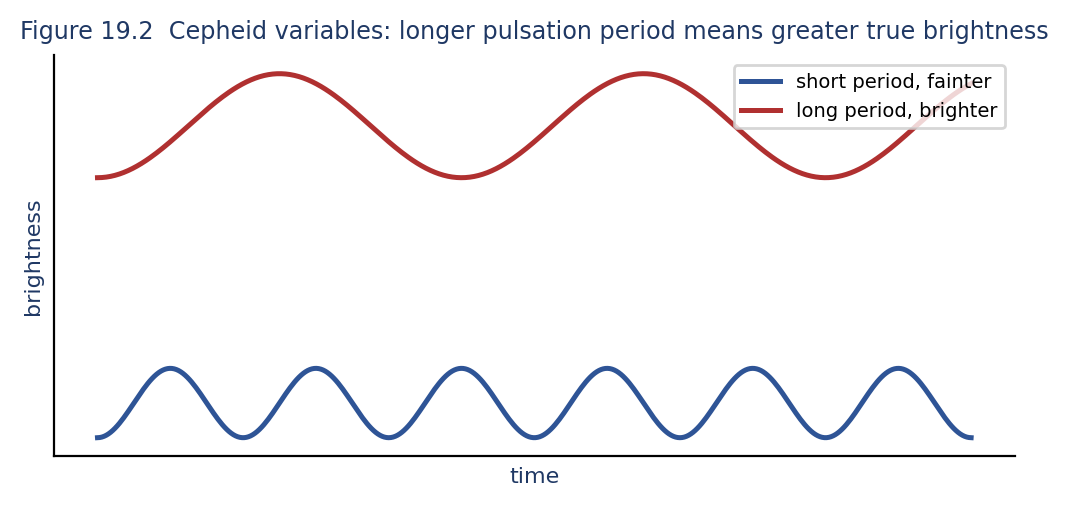
These pulsating stars act as standard markers, sometimes called standard candles, that can be seen across enormous distances, even in other galaxies. They were the key that first allowed astronomers to measure the distances to other galaxies and to begin mapping the universe on the largest scales.
Chapter Summary
Astronomical distances are measured in the astronomical unit within the solar system and in the light year and parsec for the stars, where a parsec is about three and a quarter light years. The distance to a nearby star is found by parallax, the small shift in its apparent position as the Earth orbits the Sun, with distance in parsecs equal to one divided by the parallax angle in arcseconds. Parallax works only for nearby stars, so for greater distances astronomers use Cepheid variables, whose pulsation period reveals their true luminosity, letting them serve as standard markers even in other galaxies.
Key Terms
Parsec: a unit of distance about three and a quarter light years, used for the stars
Parallax: the apparent shift of a nearby star against the background as the Earth orbits, used to measure distance
Arcsecond: a very small unit of angle in which parallax is measured
Cepheid variable: a pulsating star whose period reveals its true luminosity, used as a distance marker
Standard candle: an object of known true brightness used to measure distance
Review Questions
1. A star has a parallax of one quarter of an arcsecond. How far away is it in parsecs?
Answer: Four parsecs, because distance equals one divided by the parallax, and one divided by one quarter is four.
2. Why does parallax fail for very distant stars?
Answer: Because the apparent shift becomes too small to measure as distance increases.
3. How does a Cepheid variable reveal its true luminosity?
Answer: By its pulsation period: the longer the period, the greater the true luminosity.
Chapter 20. Between the Stars: Gas and Dust in Space
Adapted from OpenStax Astronomy 2e (CC BY-NC-SA 4.0). Complementary notes provided free of charge by E2 Innovations LLC for Virginia Research Institute.
Pairs with Lecture 4, Between the Stars: Gas and Dust in Space
Learning Objectives
After completing this chapter, you should be able to:
Describe the interstellar medium of gas and dust.
Distinguish glowing emission nebulae from dark, dusty nebulae.
Explain how interstellar dust dims and reddens starlight.
Describe the life cycle of material between the stars.
The space between the stars is not truly empty. It is filled with a thin mixture of gas and dust that forms glowing clouds, hides distant stars, and serves as both the birthplace and the graveyard of stars. This chapter examines this interstellar medium and its cycle.
20.1 The Interstellar Medium
Spread thinly throughout the space between the stars is the interstellar medium, a mixture of gas and tiny solid particles of dust. It is far more rarefied than the best vacuum made on the Earth, yet because space is so vast, the total amount of this material is enormous, adding up to a significant fraction of the mass of the galaxy. In places the gas and dust gather into clouds called nebulae, which come in strikingly different forms.
20.2 Interstellar Gas
Most of the interstellar medium is gas, chiefly hydrogen. Near a hot, luminous star, the star’s intense ultraviolet light energizes the surrounding gas and makes it glow, producing a beautiful glowing cloud called an emission nebula. These glowing clouds mark regions where hot young stars have recently formed, and their light, spread into a spectrum, reveals the composition of the gas.
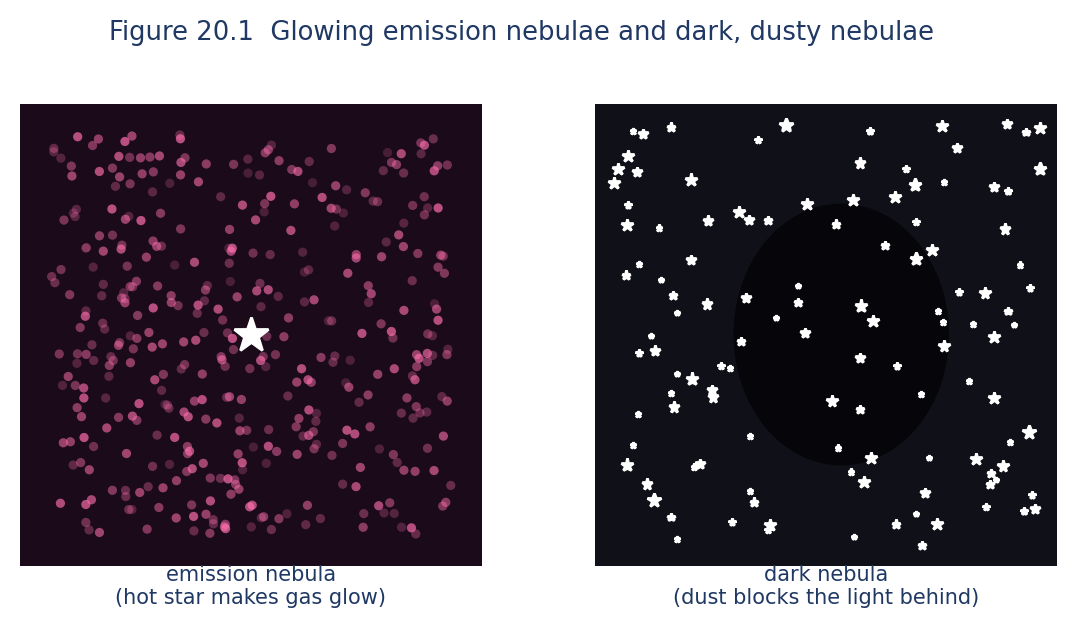
20.3 Cosmic Dust
Mixed in with the gas is interstellar dust, tiny solid grains that have a large effect despite their small amount. Dust dims the light of stars behind it, an effect called extinction, and it also reddens their light, because it scatters blue light more than red, much as dust in the Earth’s air reddens the setting Sun. Where the dust is thick, it can block the light of stars behind it entirely, creating a dark nebula that appears as a starless patch against the richer background of the Milky Way.
This dimming and reddening must be taken into account whenever astronomers measure the true colors and brightnesses of distant stars. If it were ignored, the dust would make stars appear cooler and fainter, and therefore farther away, than they really are. Learning to measure and correct for the effect of dust is an important part of studying the distant parts of our galaxy.
20.5 The Life Cycle of Cosmic Material
The interstellar medium is not static; it takes part in a great cycle. Stars are born when dense clouds of gas and dust collapse under their own gravity. During their lives and especially at their deaths, stars return material to space, enriched with the heavier elements they have manufactured. This enriched gas mixes back into the interstellar medium, from which new generations of stars and planets later form.
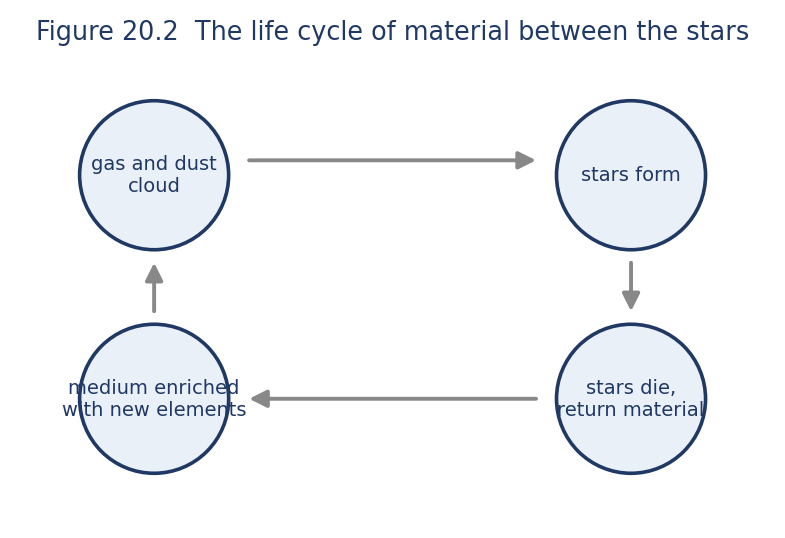
This cycle means that the atoms in our own bodies, the carbon, oxygen, and iron, were forged inside earlier generations of stars and scattered into space before the Sun was born. In a very real sense, we are made of stardust, and the gas and dust between the stars is the thread that connects one generation of stars to the next.
Chapter Summary
The space between the stars holds the interstellar medium, a thin mixture of gas and dust that, spread through the vast galaxy, adds up to a great deal of mass. Most of it is hydrogen gas, which glows as an emission nebula when energized by a nearby hot star. Interstellar dust dims and reddens the light of stars behind it, and where thick it forms a dark nebula. This material takes part in a life cycle: stars form from collapsing clouds and return enriched material at their deaths, from which new stars and planets form, so that the atoms in our bodies were forged in earlier stars.
Key Terms
Interstellar medium: the thin mixture of gas and dust that fills the space between the stars
Nebula: a cloud of interstellar gas and dust
Emission nebula: a glowing cloud of gas energized by the ultraviolet light of a nearby hot star
Interstellar dust: tiny solid grains that dim and redden the light of stars behind them
Dark nebula: a dense, dusty cloud that blocks the light of stars behind it
Review Questions
1. What is the interstellar medium made of?
Answer: A thin mixture of gas, mostly hydrogen, and tiny solid grains of dust.
2. What makes an emission nebula glow?
Answer: The intense ultraviolet light of a nearby hot star energizes the surrounding gas and makes it glow.
3. How does interstellar dust affect the light of stars behind it?
Answer: It dims the light, an effect called extinction, and reddens it by scattering blue light more than red.
4. In what sense are we made of stardust?
Answer: The heavier atoms in our bodies were forged inside earlier stars and returned to space before the Sun and Earth formed.
Module 6How Stars Are Born, How They Live and Die, and the Galaxy That Holds Them
This module follows the full life story of the stars, from their birth in clouds of gas and dust, through their long lives, to their varied deaths as white dwarfs, neutron stars, and black holes. It then steps back to the Milky Way, the galaxy of hundreds of billions of stars in which the Sun resides. It contains five chapters, and each chapter pairs with one of the module lectures.
Chapter 21. The Birth of Stars and the Discovery of Planets outside the Solar System
Adapted from OpenStax Astronomy 2e (CC BY-NC-SA 4.0). Complementary notes provided free of charge by E2 Innovations LLC for Virginia Research Institute.
Pairs with Lecture 1, The Birth of Stars and the Discovery of Planets
Learning Objectives
After completing this chapter, you should be able to:
Describe how stars form from clouds of gas and dust.
Explain how planets are detected around other stars.
Describe the transit and wobble methods of finding exoplanets.
Summarize what the discovery of exoplanets has revealed.
Stars are not eternal; they are born, and they are born from the very interstellar medium studied in the previous module. This chapter follows the birth of a star and then turns to one of the great discoveries of recent decades, that planets orbit other stars throughout the galaxy.
21.1 Star Formation
Stars form inside cold, dense clouds of gas and dust in the interstellar medium. Where such a cloud is dense enough, its own gravity pulls it inward, and as it collapses it breaks into clumps, each of which may become a star. As a clump contracts, it spins faster and heats up at the center, forming a warm, dense ball called a protostar, surrounded by a flattened disk of leftover material.
The protostar continues to shrink and grow hotter until, at last, its core becomes hot and dense enough for nuclear fusion to begin. At that moment fusion turns on, the object becomes a true star, and it settles onto the main sequence to begin the long, stable phase of its life. The disk of leftover material around the young star is the birthplace of planets, which is why star formation and planet formation go hand in hand.
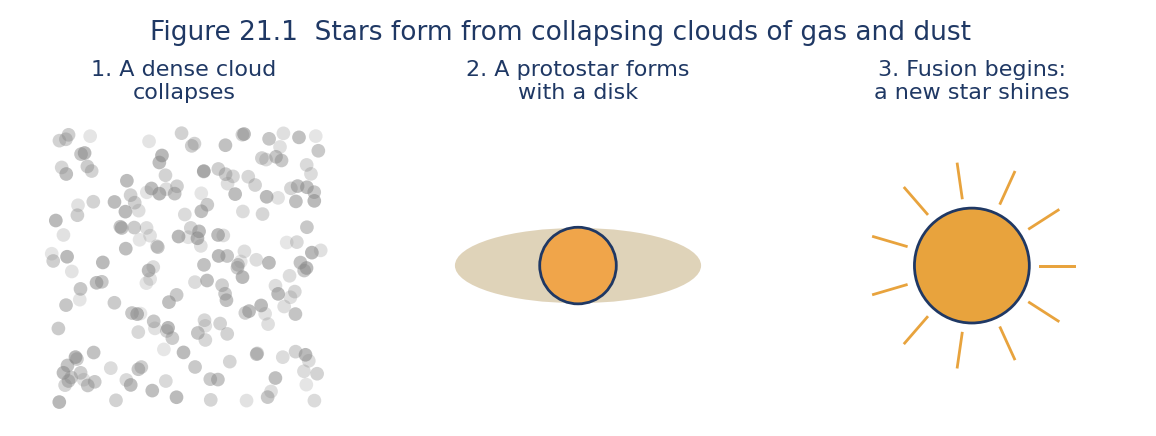
21.4 Planets beyond the Solar System: Search and Discovery
For centuries, whether other stars had planets was a matter of pure speculation, because a planet is far too faint and too close to its star to see directly. Astronomers found ways around this. In the transit method, described earlier, a planet passing in front of its star dims the star’s light slightly and regularly. In the second main method, astronomers watch for a tiny wobble in the star’s motion.
The wobble arises because a planet and its star both orbit their common center of mass, so the planet’s gravity tugs the star into a small circle. This wobble is far too small to see directly, but it produces a tiny Doppler shift in the star’s spectrum, shifting the lines slightly toward the blue and then the red as the star moves toward and away from us. Detecting that rhythmic shift reveals the unseen planet.
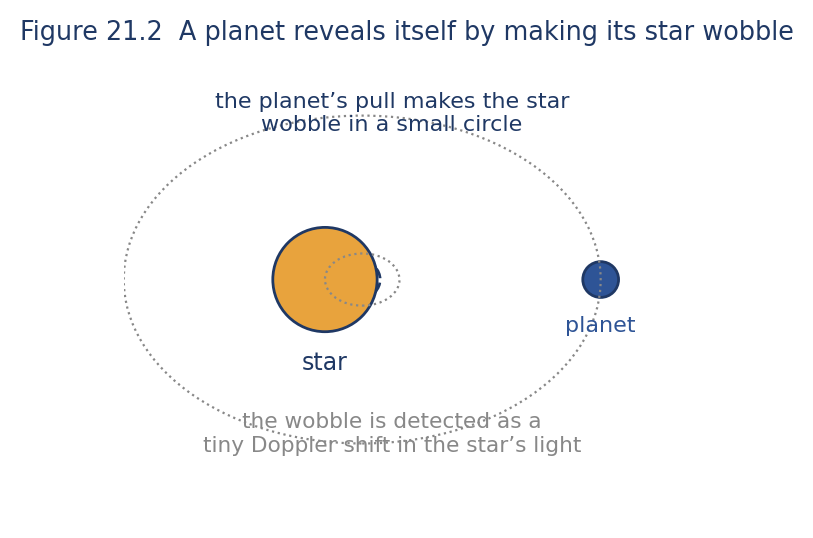
21.5 Exoplanets Everywhere
These methods have transformed astronomy. Thousands of exoplanets are now known, and the lesson is clear: planets are common, and most stars have them. The discovered worlds are remarkably varied, including giant planets orbiting closer to their stars than Mercury is to the Sun, and planets of sizes not found in our own system. Some lie in the range of distances where liquid water, and perhaps life, could exist. The search for such worlds, and for signs of life on them, is now one of the most active frontiers in all of science.
Chapter Summary
Stars form when cold, dense clouds of gas and dust collapse under gravity into protostars, which continue to shrink and heat until fusion begins in the core and a true star settles onto the main sequence, with a leftover disk that forms planets. Planets around other stars, too faint to see directly, are found by the transit method, in which the planet dims its star, and by the wobble method, in which the planet’s pull makes the star move in a small circle detected as a Doppler shift. Thousands of exoplanets are now known, showing that planets are common and remarkably varied, and the search for habitable worlds is a leading frontier.
Key Terms
Protostar: a warm, dense, contracting ball of gas that becomes a star once fusion begins
Main sequence: the long, stable phase of a star’s life, fusing hydrogen into helium
Transit method: detecting a planet by the slight, regular dimming as it passes in front of its star
Wobble method: detecting a planet by the small Doppler shift as its gravity makes the star move in a circle
Exoplanet: a planet orbiting a star other than the Sun
Review Questions
1. What must happen for a collapsing protostar to become a true star?
Answer: Its core must become hot and dense enough for nuclear fusion to begin.
2. How does the wobble method reveal a planet?
Answer: The planet’s gravity makes the star move in a small circle, producing a tiny Doppler shift in the star’s spectrum.
3. What has the discovery of thousands of exoplanets shown about planets in the galaxy?
Answer: That planets are common, most stars have them, and they are remarkably varied.
Chapter 22. Stars from Adolescence to Old Age
Adapted from OpenStax Astronomy 2e (CC BY-NC-SA 4.0). Complementary notes provided free of charge by E2 Innovations LLC for Virginia Research Institute.
Pairs with Lecture 2, Stars from Adolescence to Old Age
Learning Objectives
After completing this chapter, you should be able to:
Explain how a star spends the main part of its life.
Describe how a star changes when its core hydrogen runs out.
Explain why a star swells into a red giant.
Describe how a star’s mass sets the course of its life.
A star spends most of its life in a long, stable middle age, but that stability does not last forever. This chapter follows a star from its steady adulthood to the dramatic changes of old age, when it swells into a giant.
22.1 Evolution from the Main Sequence to Red Giants
For most of its life a star sits on the main sequence, steadily fusing hydrogen into helium in its core. This phase is long and stable because the star is in balance, with gravity pulling in and the pressure from fusion pushing out. The Sun has been on the main sequence for billions of years and will remain there for billions more.
Eventually, however, the hydrogen fuel in the core runs out. With less energy pushing out, the core contracts and heats, and the outer layers of the star respond by expanding enormously and cooling. The star swells into a red giant, many times its original size, with a cooler, redder surface. In this later phase the star begins to fuse helium into heavier elements in its core, and it lives very differently from its main sequence days.
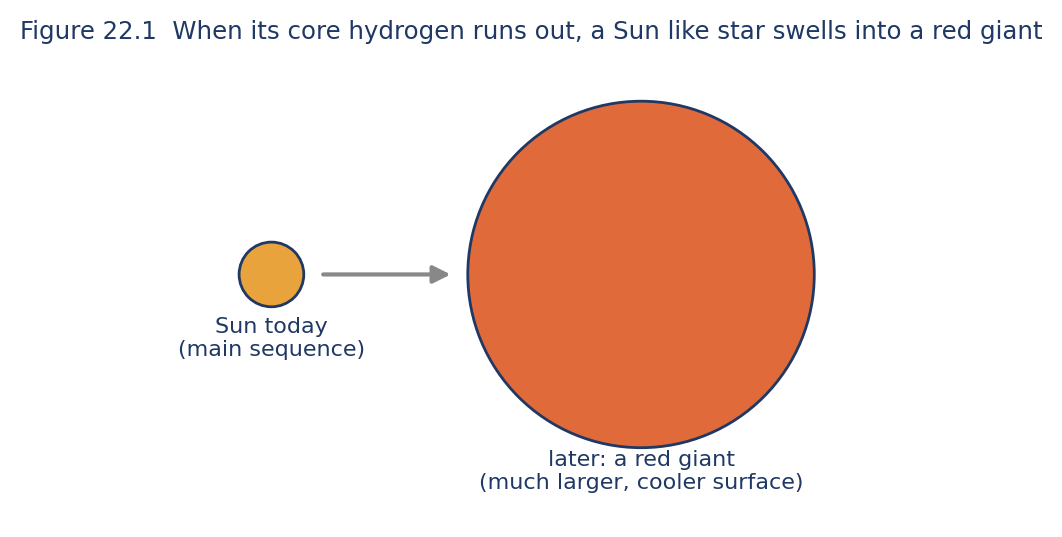
22.4 Further Evolution of Stars
As a star ages, it can fuse successively heavier elements, building up layers like the layers of an onion, with the heaviest elements deepest inside where the temperature is greatest. Each stage of fusion tends to be shorter than the one before. The details depend strongly on the star’s mass: a modest star like the Sun can go only so far, while a much more massive star can push fusion to far heavier elements.
22.5 The Evolution of More Massive Stars
The single most important factor in a star’s life is its mass. Massive stars are hotter, burn their fuel far faster, and live much shorter lives than low mass stars, even though they have more fuel to begin with. A very massive star races through its stages and can build an inner core of iron, the point at which fusion can no longer release energy. What happens next, at the end of a star’s life, depends on this mass, and it is the subject of the next chapter. In short, a star’s mass at birth largely writes the story of how it will live and how it will die.
Chapter Summary
A star spends most of its life on the main sequence, steadily and stably fusing hydrogen into helium in its core. When the core hydrogen runs out, the core contracts and heats while the outer layers expand and cool, so the star swells into a red giant and begins fusing helium into heavier elements. As it ages a star can fuse successively heavier elements in onion like layers, and how far this goes depends on its mass. Mass is the most important factor in a star’s life: massive stars burn faster and live shorter lives, and a very massive star can build an iron core, setting the stage for its death.
Key Terms
Red giant: a late stage star that has swollen enormously and cooled after exhausting its core hydrogen
Helium fusion: the fusing of helium into heavier elements that begins in a red giant’s core
Stellar mass: the amount of matter in a star, the key factor setting how it lives and dies
Iron core: the innermost core built up in a very massive star, where fusion can no longer release energy
Review Questions
1. What is a star doing during its long, stable main sequence life?
Answer: Steadily fusing hydrogen into helium in its core, in balance between gravity and pressure.
2. Why does a star swell into a red giant when its core hydrogen runs out?
Answer: The core contracts and heats, and the outer layers respond by expanding greatly and cooling.
3. How does mass affect the length of a star’s life?
Answer: More massive stars burn their fuel faster and live much shorter lives than low mass stars.
Chapter 23. The Death of Stars
Adapted from OpenStax Astronomy 2e (CC BY-NC-SA 4.0). Complementary notes provided free of charge by E2 Innovations LLC for Virginia Research Institute.
Pairs with Lecture 3, The Death of Stars
Learning Objectives
After completing this chapter, you should be able to:
Describe how a low mass star like the Sun ends its life.
Describe how a massive star dies in a supernova.
Explain what a neutron star is and how pulsars were discovered.
Explain how a star’s mass determines its final fate.
Every star must eventually die, and how it dies is determined above all by its mass. This chapter follows the two great paths to a star’s end, the gentle fading of low mass stars and the violent explosion of massive ones.
23.1 The Death of Low Mass Stars
A low mass star like the Sun ends its life relatively gently. After its red giant phase, it is unable to fuse elements beyond a certain point, and it gently pushes off its outer layers, which drift away into space as a beautiful, expanding shell of glowing gas called a planetary nebula. The name is historical and misleading, for these have nothing to do with planets. What remains at the center is the hot, exposed core, now a small, dense, slowly cooling star called a white dwarf, about the size of the Earth but far denser. A white dwarf produces no new energy and simply fades over billions of years.
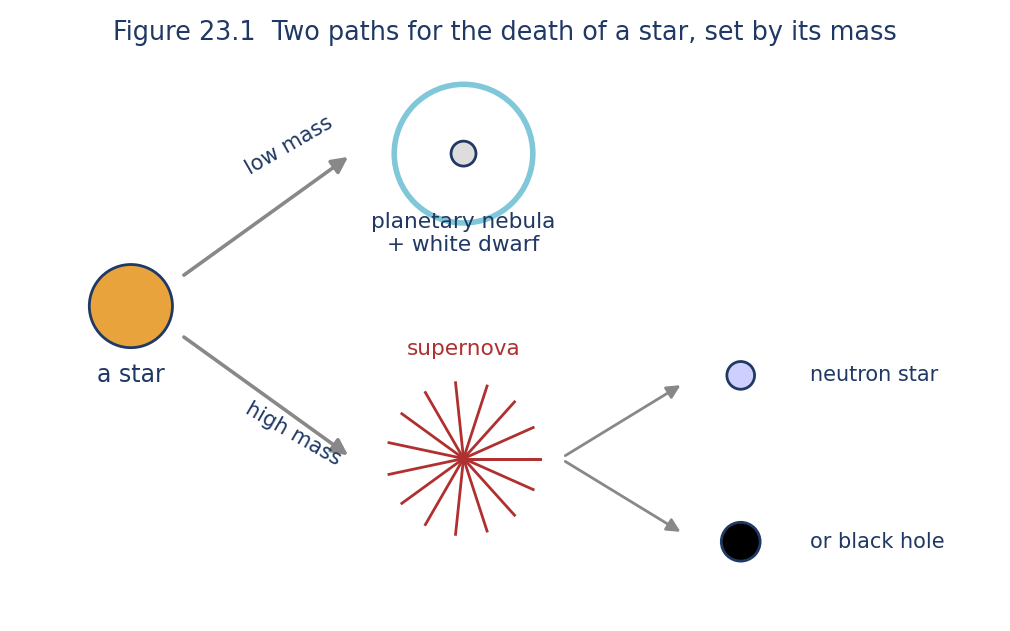
23.2 Evolution of Massive Stars: An Explosive Finish
A massive star meets a far more violent end. Once it has built an iron core, fusion can no longer support it, and the core suddenly collapses in a fraction of a second. The collapse releases a colossal burst of energy that blows the rest of the star apart in a titanic explosion called a supernova, which can briefly outshine an entire galaxy. A supernova scatters the elements the star has made, including the heavy elements essential to planets and life, out into space to enrich the interstellar medium.
23.4 Pulsars and the Discovery of Neutron Stars
The collapsed core left behind by a supernova can become a neutron star, an object so dense that a sugar cube of its material would weigh as much as a mountain, packing more than the mass of the Sun into a ball only kilometers across. Many neutron stars spin rapidly and sweep beams of radiation around like a lighthouse. When such a beam sweeps across the Earth, we detect regular pulses, and the object is called a pulsar. The discovery of these steady cosmic pulses was the first evidence that neutron stars, long predicted, truly exist. If the collapsing core is heavier still, not even a neutron star can form, and it collapses further into a black hole, the subject of the next chapter.
Chapter Summary
A star’s death is determined by its mass. A low mass star like the Sun gently sheds its outer layers as a glowing planetary nebula and leaves behind a small, dense, fading white dwarf. A massive star, once it has built an iron core, collapses and explodes as a supernova that can outshine a galaxy and scatters heavy elements into space. The collapsed core can become a neutron star, incredibly dense, and if it spins and beams radiation past the Earth we detect it as a pulsar. If the core is heavier still, it collapses further into a black hole.
Key Terms
Planetary nebula: the glowing shell of gas shed by a dying low mass star, unrelated to planets
White dwarf: the small, dense, fading core left behind by a low mass star
Supernova: the titanic explosion that ends the life of a massive star, scattering heavy elements
Neutron star: an extremely dense collapsed stellar core, only kilometers across
Pulsar: a spinning neutron star whose beam of radiation sweeps past the Earth as regular pulses
Review Questions
1. How does a low mass star like the Sun end its life?
Answer: It sheds its outer layers as a planetary nebula and leaves behind a small, dense, fading white dwarf.
2. What is a supernova, and why is it important for the universe?
Answer: The explosive death of a massive star, which scatters heavy elements into space to enrich the interstellar medium.
3. What is a pulsar?
Answer: A rapidly spinning neutron star whose beam of radiation sweeps past the Earth, producing regular pulses.
Chapter 24. Black Holes and Curved Spacetime
Adapted from OpenStax Astronomy 2e (CC BY-NC-SA 4.0). Complementary notes provided free of charge by E2 Innovations LLC for Virginia Research Institute.
Pairs with Lecture 4, Black Holes and Curved Spacetime
Learning Objectives
After completing this chapter, you should be able to:
Describe how general relativity pictures gravity as curved spacetime.
Explain what a black hole is and what the event horizon is.
Explain why not even light can escape a black hole.
Describe how astronomers find black holes they cannot see.
The most extreme objects that stars can leave behind are black holes, regions where gravity is so strong that nothing can escape. Understanding them requires a new picture of gravity itself, given by Einstein’s theory of general relativity.
24.1 Introducing General Relativity
Newton described gravity as a force acting between masses, and his description works beautifully for most purposes. But Einstein’s theory of general relativity offers a deeper picture. In it, gravity is not a force reaching across empty space but a curving of space and time itself, caused by the presence of mass.
24.2 Spacetime and Gravity
In general relativity, mass curves the space and time, or spacetime, around it, and other objects then move along the curves. A common image is a heavy ball resting on a stretched rubber sheet: the ball makes a dip, and a marble rolling nearby curves around it. Planets orbit the Sun not because a force pulls them across space, but because they follow the curves that the Sun’s mass makes in spacetime. The greater the mass, the deeper the curvature, and the stronger the gravity.
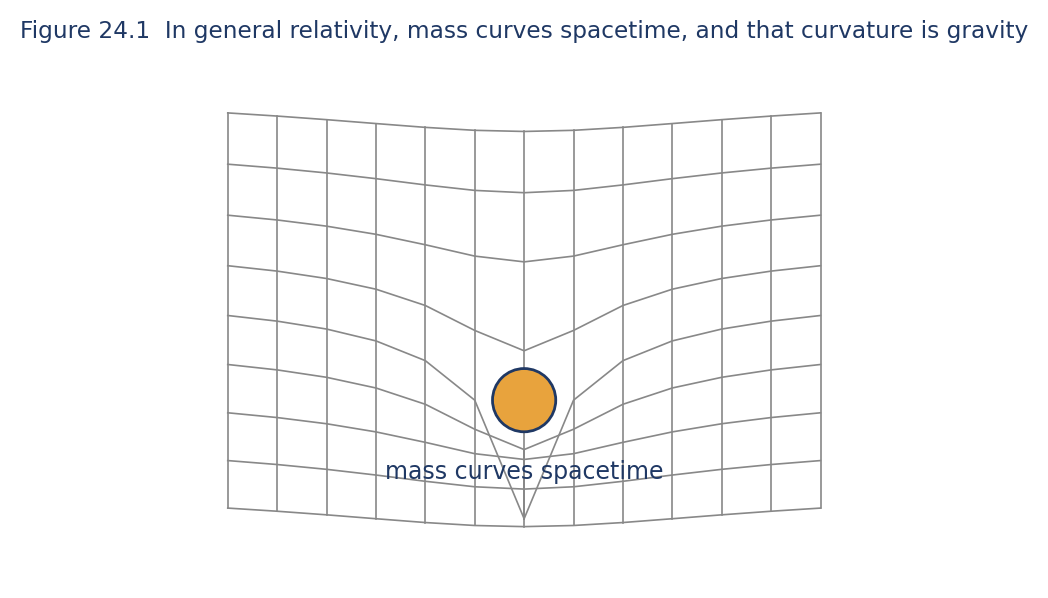
24.5 Black Holes
When the core left by a very massive star is too heavy to become a neutron star, gravity wins completely and crushes it into a black hole, a region where matter is compressed so tightly that the curvature of spacetime becomes extreme. Around the black hole is a boundary called the event horizon. Anything that crosses the event horizon, including light itself, can never escape, because escaping would require moving faster than light, which is impossible. That is why a black hole is black: no light can leave it.
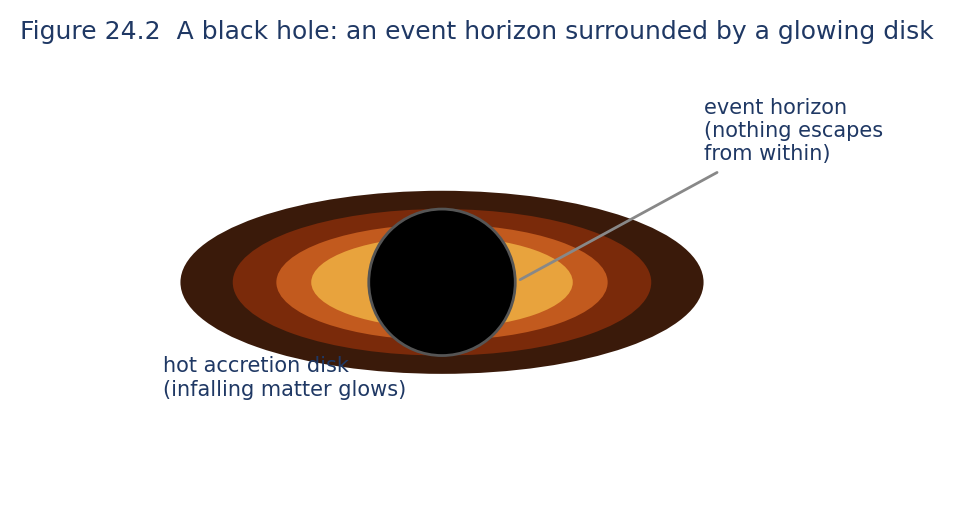
24.6 Evidence for Black Holes
Because a black hole emits no light, it cannot be seen directly, and astronomers find them by their effects on their surroundings. Gas falling toward a black hole forms a hot, swirling accretion disk that glows brightly, often in X rays, before crossing the event horizon. And a black hole’s gravity makes nearby stars orbit an invisible point, and by measuring those orbits astronomers can weigh the unseen object and confirm it is a black hole. In these ways the invisible reveals itself through the visible.
Chapter Summary
Einstein’s general relativity pictures gravity not as a force but as the curving of spacetime by mass, so that objects orbit by following those curves, and the greater the mass, the deeper the curvature. When the core left by a very massive star is too heavy to become a neutron star, it collapses into a black hole, whose event horizon is a boundary beyond which nothing, not even light, can escape. Black holes emit no light, so astronomers find them by their effects: the bright, hot accretion disk of gas falling in, and the orbits of nearby stars around an invisible point that reveal its mass.
Key Terms
General relativity: Einstein’s theory that gravity is the curving of spacetime by mass
Spacetime: the combined fabric of space and time that mass curves
Black hole: a region where gravity is so strong that nothing, not even light, can escape
Event horizon: the boundary of a black hole, beyond which nothing can escape
Accretion disk: the hot, glowing disk of matter spiraling toward a black hole
Review Questions
1. In general relativity, what is gravity?
Answer: The curving of spacetime caused by mass, along which objects move.
2. What is the event horizon of a black hole?
Answer: The boundary beyond which nothing, not even light, can escape.
3. Since a black hole emits no light, how do astronomers detect one?
Answer: By its effects, such as the glowing accretion disk of infalling gas and the orbits of nearby stars around an invisible point.
Chapter 25. The Milky Way Galaxy
Adapted from OpenStax Astronomy 2e (CC BY-NC-SA 4.0). Complementary notes provided free of charge by E2 Innovations LLC for Virginia Research Institute.
Pairs with Lecture 5, The Milky Way Galaxy
Learning Objectives
After completing this chapter, you should be able to:
Describe the structure of the Milky Way and the Sun’s place in it.
Describe the spiral structure of the galaxy.
Explain the evidence for dark matter in the galaxy.
Describe what lies at the center of the Milky Way.
All the stars we have studied belong to a single vast system, the Milky Way Galaxy. This chapter steps back to see the galaxy as a whole: its shape, the Sun’s place in it, the mysterious dark matter it contains, and the monster at its center.
25.1 The Architecture of the Galaxy
The Milky Way is a spiral galaxy, a great pinwheel of several hundred billion stars, together with gas and dust. It has three main parts: a thin, flat disk in which the stars, gas, and spiral arms lie; a central bulge of stars around the middle; and a vast, roughly spherical halo of older stars and star clusters surrounding the whole. The Sun is not at the center but sits partway out in the disk, about halfway to the edge, which is why we see the rest of the galaxy as a band of light across our night sky.
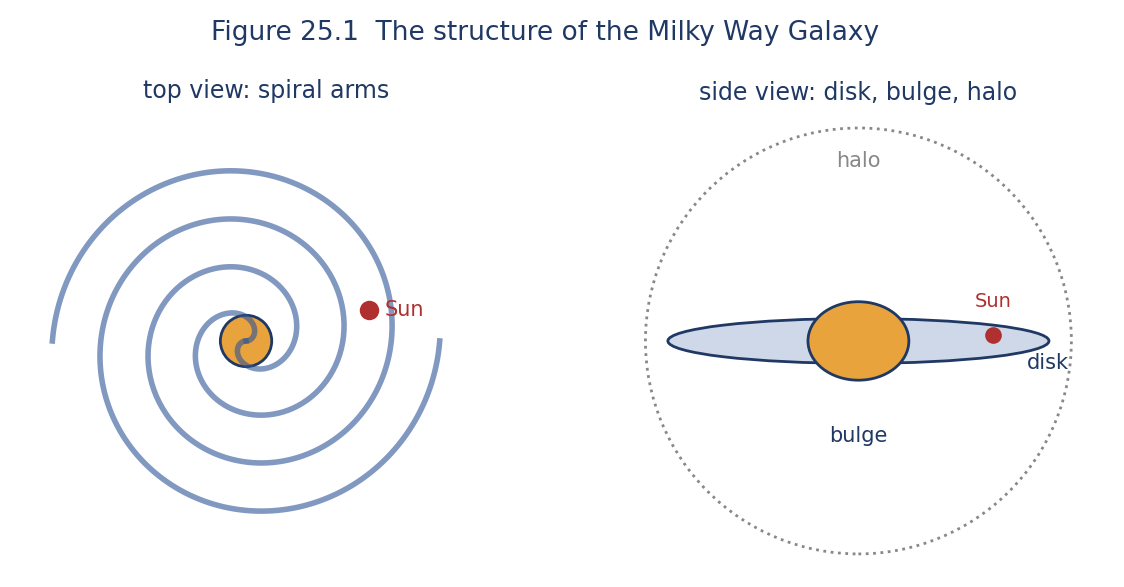
25.2 Spiral Structure
Within the disk, the brightest stars and glowing gas clouds are gathered into graceful spiral arms that wind outward from the center. These arms are regions where star formation is especially active, lit up by hot young stars, which is why they stand out. The spiral pattern is one of the defining features of galaxies like our own.
25.3 The Mass of the Galaxy
By measuring how fast stars and gas orbit the center of the galaxy at different distances, astronomers can weigh the galaxy. The result is surprising: the outer parts orbit far faster than the visible stars and gas can explain. This means the galaxy contains a great deal of unseen matter, called dark matter, which gives off no light but makes its presence known through its gravity. Dark matter appears to make up most of the mass of the galaxy, and indeed of the universe, yet its nature remains one of the deepest unsolved puzzles in science.
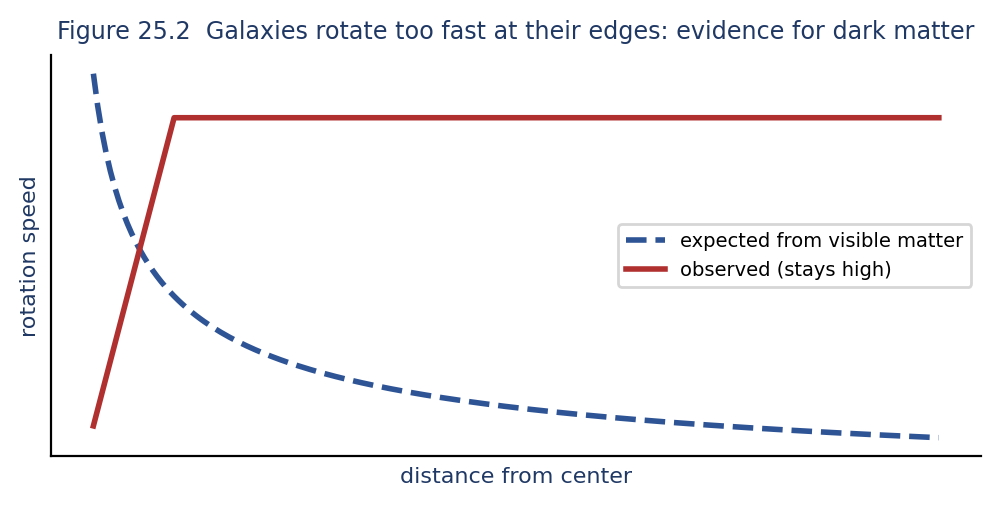
25.4 The Center of the Galaxy
At the very center of the Milky Way lies a supermassive black hole, millions of times the mass of the Sun. Astronomers cannot see it, but they have watched stars near the center whip around an invisible point at enormous speeds, and only the gravity of such a black hole can explain their orbits. Supermassive black holes are now thought to lie at the centers of most large galaxies, a striking link between the smallest and largest scales of the cosmos, and a fitting place to end our tour of the Milky Way.
Chapter Summary
The Milky Way is a spiral galaxy of several hundred billion stars, with a flat disk containing the spiral arms, a central bulge, and a surrounding halo, and the Sun sits partway out in the disk rather than at the center. The bright spiral arms are regions of active star formation. Measuring how fast the outer galaxy rotates reveals far more mass than the visible matter can account for, evidence for dark matter, which is unseen but dominates the galaxy’s mass and remains a deep mystery. At the center of the galaxy lies a supermassive black hole, millions of times the mass of the Sun, revealed by the fast orbits of stars around it.
Key Terms
Spiral galaxy: a galaxy, like the Milky Way, with a flat disk and spiral arms
Disk: the thin, flat part of the galaxy containing the stars, gas, and spiral arms
Halo: the vast, roughly spherical region of older stars and clusters surrounding the galaxy
Dark matter: unseen matter that gives off no light but reveals itself through its gravity, dominating the galaxy’s mass
Supermassive black hole: the black hole of millions of solar masses at the center of the galaxy
Review Questions
1. What are the three main parts of the Milky Way, and where is the Sun?
Answer: A flat disk, a central bulge, and a surrounding halo; the Sun sits partway out in the disk, not at the center.
2. What is the evidence for dark matter in the galaxy?
Answer: The outer galaxy rotates far faster than the visible matter can explain, so unseen matter must be present.
3. What lies at the center of the Milky Way, and how is it detected?
Answer: A supermassive black hole, detected by the fast orbits of stars around an invisible point.
Module 7The Realm of Galaxies, the Story of the Whole Universe, and the Search for Life
This final module reaches the largest scales of all. It surveys the galaxies that fill the universe, the brilliant quasars powered by giant black holes, and the way galaxies are distributed and have evolved. It then tells the story of the whole universe, from the Big Bang to its present makeup of dark matter and dark energy, and closes with the question of life beyond the Earth. It contains five chapters, and each pairs with one of the module lectures.
Chapter 26. Galaxies
Adapted from OpenStax Astronomy 2e (CC BY-NC-SA 4.0). Complementary notes provided free of charge by E2 Innovations LLC for Virginia Research Institute.
Pairs with Lecture 1, Galaxies
Learning Objectives
After completing this chapter, you should be able to:
Describe how galaxies were discovered to lie far beyond the Milky Way.
Distinguish the main types of galaxies.
Describe the range of properties among galaxies.
Explain how the expansion of the universe was discovered.
The Milky Way is not alone. It is one of hundreds of billions of galaxies scattered through the universe, and studying them reveals not only their variety but the astonishing fact that the whole universe is expanding. This chapter introduces the galaxies and that great discovery.
26.1 The Discovery of Galaxies
For a long time, astronomers were unsure whether the faint, fuzzy patches of light they called nebulae lay within the Milky Way or far beyond it. The question was settled in the twentieth century when astronomers measured the distance to one such patch, using Cepheid variable stars, and found it lay far outside our own galaxy. That patch was a separate galaxy in its own right. Suddenly the universe grew enormously, from a single galaxy to a vast realm containing countless others.
26.2 Types of Galaxies
Galaxies come in a few main types. Spiral galaxies, like the Milky Way, have a flat disk with graceful spiral arms and ongoing star formation. Elliptical galaxies are smooth, rounded collections of mostly older stars, with little gas and little new star formation. Irregular galaxies have no regular shape at all. This variety of forms is one of the first things a survey of the galaxies reveals.
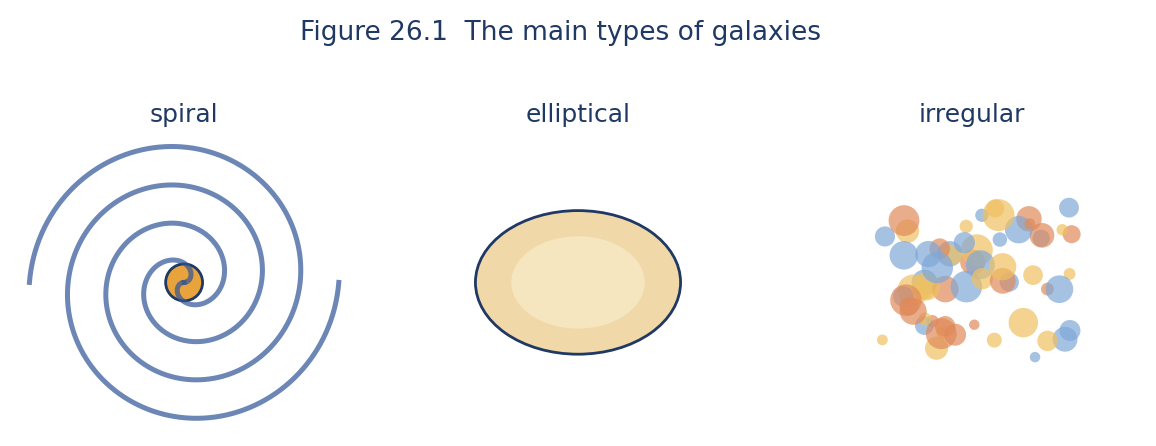
26.3 Properties of Galaxies
Galaxies span an enormous range of properties. Some are giants containing trillions of stars, while others are dwarfs with only a few million. They differ in mass, in brightness, in color, and in how much gas they contain and how many new stars they are forming. Measuring these properties for many galaxies is how astronomers learn what galaxies are and how they change over time.
26.5 The Expanding Universe
The most profound discovery about the galaxies is that they are moving apart. When astronomers measured the spectra of many galaxies, they found that almost all are redshifted, meaning they are moving away from us, and that the more distant a galaxy is, the faster it is receding. This relationship is called Hubble’s law.
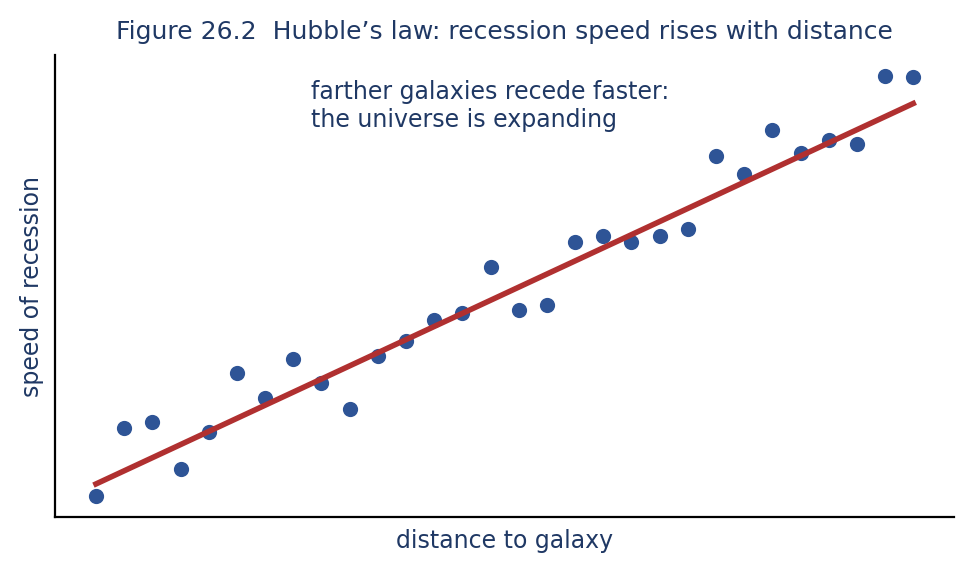
Hubble’s law can be written as a simple proportion: a galaxy’s recession speed equals a constant times its distance.

This does not mean we are at the center of some explosion. Rather, space itself is expanding, carrying the galaxies apart from one another, so that observers in any galaxy would see the same thing. The discovery that the universe is expanding is one of the great turning points in the history of science, and it points back to a beginning, the subject of a later chapter.
Chapter Summary
Galaxies were shown to lie far beyond the Milky Way when the distance to a nearby one was measured with Cepheid variables, revealing a universe of hundreds of billions of galaxies. Galaxies come in main types, the spiral, the elliptical, and the irregular, and they span an enormous range of mass, brightness, and star formation. Above all, the galaxies are moving apart: almost all are redshifted, and the more distant a galaxy is, the faster it recedes, a relationship called Hubble’s law. This means space itself is expanding, a discovery that points back to a beginning of the universe.
Key Terms
Galaxy: a vast system of stars, gas, and dust, of which the Milky Way is one of hundreds of billions
Spiral galaxy: a galaxy with a flat disk and spiral arms, like the Milky Way
Elliptical galaxy: a smooth, rounded galaxy of mostly older stars with little new star formation
Redshift: the shift of a galaxy’s light to longer wavelengths, showing it is moving away
Hubble’s law: the relationship that a galaxy’s recession speed rises with its distance
Review Questions
1. How did astronomers first show that some nebulae are separate galaxies far beyond the Milky Way?
Answer: By measuring the distance to one using Cepheid variable stars and finding it lay far outside our galaxy.
2. What does Hubble’s law state about galaxies?
Answer: That the more distant a galaxy is, the faster it is receding from us.
3. Does the expansion of the universe mean the Milky Way is at its center?
Answer: No; space itself is expanding, so observers in any galaxy would see the same recession.
Chapter 27. Active Galaxies, Quasars, and Supermassive Black Holes
Adapted from OpenStax Astronomy 2e (CC BY-NC-SA 4.0). Complementary notes provided free of charge by E2 Innovations LLC for Virginia Research Institute.
Pairs with Lecture 2, Active Galaxies, Quasars, and Supermassive Black Holes
Learning Objectives
After completing this chapter, you should be able to:
Describe what quasars are and why they were puzzling.
Explain what powers a quasar.
Connect quasars to the supermassive black holes at the centers of galaxies.
Among the galaxies are some with astonishingly bright centers, far more brilliant than an ordinary galaxy. These active galaxies and quasars puzzled astronomers for years, until their power was traced to the most extreme objects known, giant black holes. This chapter tells that story.
27.1 Quasars
Quasars were discovered as strange, starlike points of light that turned out to be enormously distant. Because they are so far away and yet still appear bright, they must be extraordinarily luminous, often outshining an entire galaxy of hundreds of billions of stars, and yet the source of all that light is a region no larger than our solar system. How such a tiny region could produce so much energy was one of the great puzzles of modern astronomy. Their name is short for quasi stellar object, a reminder that they first appeared to be nothing more than ordinary stars.
27.2 Supermassive Black Holes: What Quasars Really Are
The answer is that a quasar is powered by a supermassive black hole at the center of a galaxy. As gas falls toward the black hole, it forms a hot, swirling accretion disk that heats up and radiates enormous amounts of energy before crossing the event horizon. This is far more efficient than the nuclear fusion that powers stars, which is how so much light can come from so small a region. Many quasars also shoot out powerful jets of material.
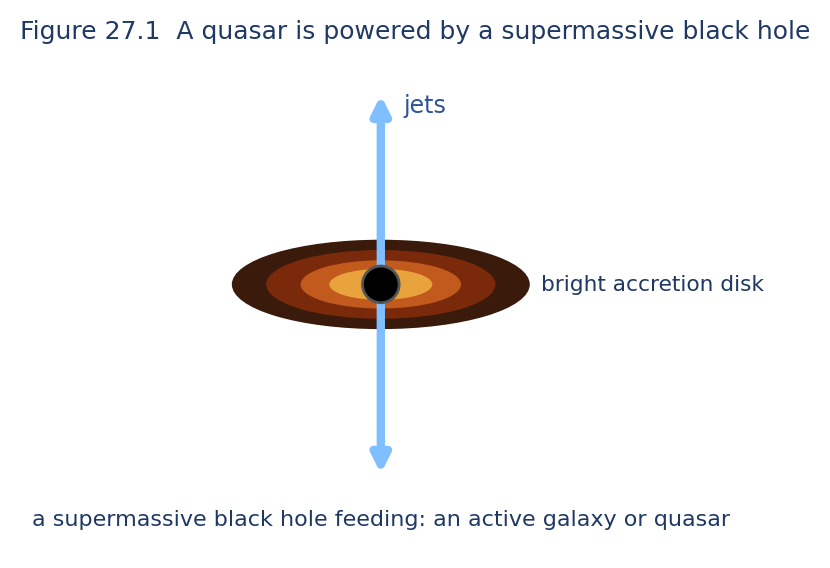
A quasar, then, is simply an active galactic nucleus, the brilliant center of a galaxy whose central black hole is actively feeding. Quasars are most common in the distant, and therefore younger, universe, which tells us that these central black holes were more active long ago. The supermassive black hole at the center of the Milky Way is a quiet, sleeping version of the same kind of monster that lights up a quasar.
Active galaxies come in a range of strengths, from the blazing quasars down to milder active centers, but all are understood as the same basic engine, a central black hole feeding at different rates. Because the brightest quasars can be seen across almost the whole universe, they also serve as beacons that let astronomers study the distant, early cosmos, making them valuable far beyond their own strangeness.
Chapter Summary
Quasars are extremely distant, starlike objects so luminous that they can outshine an entire galaxy, yet their light comes from a region no larger than the solar system, which long puzzled astronomers. The explanation is that a quasar is powered by a supermassive black hole at a galaxy’s center: gas falling into a hot accretion disk radiates enormous energy, far more efficiently than fusion, and often drives powerful jets. A quasar is an active galactic nucleus, and quasars were more common in the younger universe, showing these black holes were more active long ago. The Milky Way’s central black hole is a quiet version of the same thing.
Key Terms
Quasar: an extremely luminous, distant object powered by a supermassive black hole at a galaxy’s center
Active galactic nucleus: the brilliant center of a galaxy whose central black hole is actively feeding
Accretion disk: the hot, glowing disk of gas spiraling toward a black hole, radiating enormous energy
Jet: a powerful, narrow stream of material shot out from near a feeding black hole
Review Questions
1. Why were quasars so puzzling when first understood to be distant?
Answer: They are extraordinarily luminous, outshining a galaxy, yet the light comes from a region no larger than the solar system.
2. What powers a quasar?
Answer: A supermassive black hole at a galaxy’s center, whose hot accretion disk of infalling gas radiates enormous energy.
3. How is a quasar related to the Milky Way’s central black hole?
Answer: The Milky Way’s central black hole is a quiet version of the same kind of supermassive black hole that powers a quasar.
Chapter 28. The Evolution and Distribution of Galaxies
Adapted from OpenStax Astronomy 2e (CC BY-NC-SA 4.0). Complementary notes provided free of charge by E2 Innovations LLC for Virginia Research Institute.
Pairs with Lecture 3, The Evolution and Distribution of Galaxies
Learning Objectives
After completing this chapter, you should be able to:
Explain how observing distant galaxies lets us look back in time.
Describe the large scale distribution of galaxies.
Describe the role of dark matter on the largest scales.
Explain how galaxies form and evolve.
Galaxies are not scattered at random, nor are they unchanging. This chapter shows how looking far into space is looking back in time, how galaxies are arranged in a great cosmic web, and how they grow and change over billions of years.
28.1 Observations of Distant Galaxies
Because light takes time to travel, looking at a very distant galaxy means seeing it as it was long ago, when its light began its journey. The most distant galaxies we can see are therefore seen as they were in the early universe, billions of years in the past. This gives astronomers a kind of time machine: by comparing nearby galaxies with distant ones, they can watch how galaxies have changed over the history of the universe, and they find that early galaxies were smaller, bluer, and more irregular than those of today.
28.4 The Challenge of Dark Matter
The same dark matter found in the Milky Way turns out to dominate on the largest scales too. By measuring the motions of galaxies within clusters, astronomers find far more mass than the visible stars and gas can account for, just as within a single galaxy. Dark matter, unseen but felt through its gravity, provides much of the mass that holds clusters of galaxies together, and it forms the invisible scaffolding on which galaxies are built.
28.5 The Formation and Evolution of Galaxies
Galaxies are not fixed; they grow and change. Small galaxies formed first in the early universe, and over time they merged and grew into the larger galaxies we see today. Collisions and mergers between galaxies, which are surprisingly common, can transform their shapes, trigger bursts of new star formation, and feed their central black holes. On the largest scale, galaxies are not spread evenly but gather along a vast cosmic web of filaments and clusters, with enormous nearly empty voids in between.
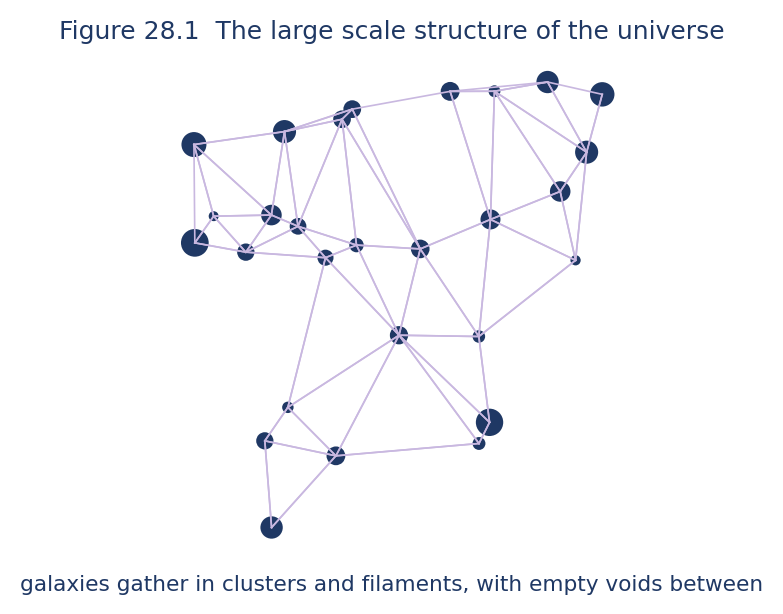
This great structure, and the galaxies strung along it, grew from tiny variations in the density of matter in the early universe, amplified over billions of years by gravity and guided by the unseen dark matter. The distribution and evolution of galaxies is thus a record of the history of the whole universe.
Chapter Summary
Because light takes time to travel, observing distant galaxies shows them as they were in the early universe, and comparing them with nearby galaxies reveals that early galaxies were smaller, bluer, and more irregular. Dark matter dominates on the largest scales, providing much of the mass that holds clusters of galaxies together, as shown by the motions of galaxies within them. Galaxies form and evolve, with small early galaxies merging into larger ones and collisions triggering star formation. On the largest scale, galaxies gather along a cosmic web of filaments and clusters separated by voids, a structure that grew from tiny density variations under the guidance of gravity and dark matter.
Key Terms
Lookback time: the idea that observing a distant galaxy shows it as it was long ago, when its light left it
Cluster of galaxies: a group of galaxies bound together, held largely by dark matter
Cosmic web: the large scale arrangement of galaxies along filaments and clusters, with voids between
Galaxy merger: a collision and combining of galaxies, which can trigger star formation and reshape them
Review Questions
1. Why does observing a very distant galaxy let us look back in time?
Answer: Its light took billions of years to reach us, so we see it as it was long ago when the light left it.
2. What evidence shows dark matter dominates within clusters of galaxies?
Answer: The motions of galaxies within clusters require far more mass than the visible stars and gas provide.
3. How did large galaxies come to be, and how are galaxies arranged on the largest scale?
Answer: Small early galaxies merged into larger ones, and galaxies gather along a cosmic web of filaments and clusters with voids between.
Chapter 29. The Big Bang
Adapted from OpenStax Astronomy 2e (CC BY-NC-SA 4.0). Complementary notes provided free of charge by E2 Innovations LLC for Virginia Research Institute.
Pairs with Lecture 4, The Big Bang
Learning Objectives
After completing this chapter, you should be able to:
Explain how the expansion of the universe implies an age and a beginning.
Describe the Big Bang as the hot, dense beginning of the universe.
Describe the cosmic microwave background and why it is key evidence.
Summarize what the universe is made of.
If the universe is expanding, then in the past it was smaller, denser, and hotter, and running the expansion backward points to a beginning. This chapter tells the story of that beginning, the Big Bang, the evidence that confirms it, and the surprising makeup of the universe it produced.
29.1 The Age of the Universe
The expansion of the universe gives it an age. If the galaxies are moving apart now, then long ago they were all much closer together, and by measuring how fast the universe is expanding, astronomers can calculate how long ago that was. The answer is that the universe is about fourteen billion years old. Everything we see, including the Earth and the Sun, has come into being within that span of time.
29.3 The Beginning of the Universe
Tracing the expansion back to its start leads to the idea of the Big Bang: the universe began about fourteen billion years ago in an extremely hot, dense state and has been expanding and cooling ever since. The Big Bang was not an explosion of matter into empty space, but an expansion of space itself, which has been stretching and carrying everything apart from the very beginning.
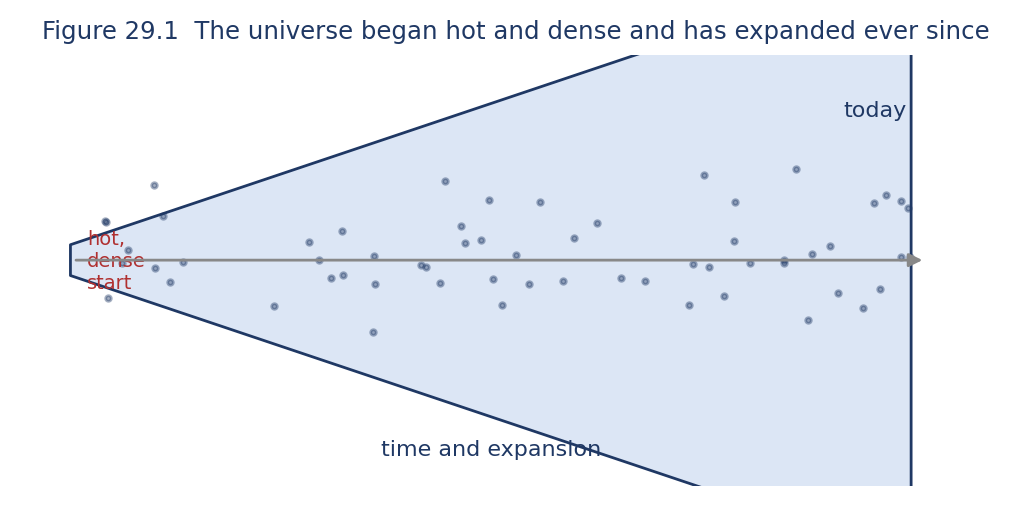
29.4 The Cosmic Microwave Background
The strongest evidence for the Big Bang is a faint glow of radiation that fills the whole sky, called the cosmic microwave background. It is the leftover heat from the early universe, released when the cosmos had cooled enough to become transparent, now stretched by the expansion into faint microwaves. Its discovery confirmed that the universe really did begin in a hot, dense state, and its tiny variations across the sky are the seeds from which galaxies later grew.
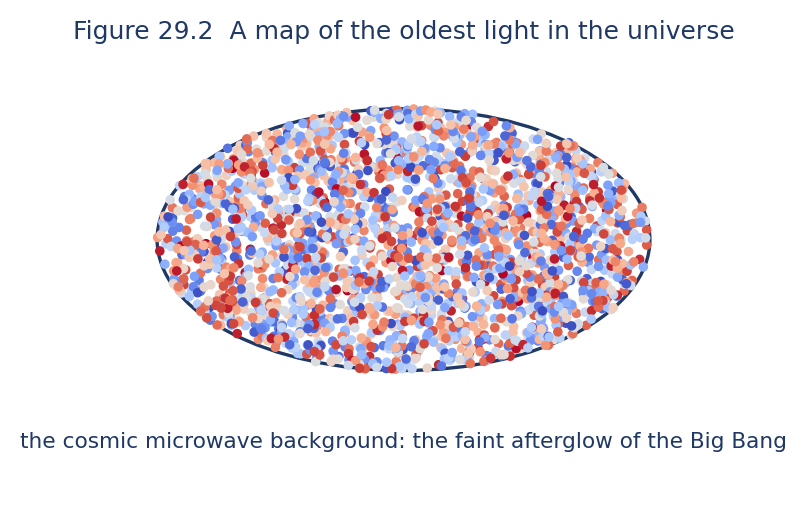
29.5 What Is the Universe Really Made Of?
One of the most startling results of modern astronomy is that the ordinary matter we are made of, the atoms of stars, planets, and people, makes up only a small fraction of the universe. Most of the universe is made of two mysterious components. Dark matter, which we have already met, makes up much more, and the largest share of all is dark energy, a still poorly understood form of energy that is causing the expansion of the universe to speed up.
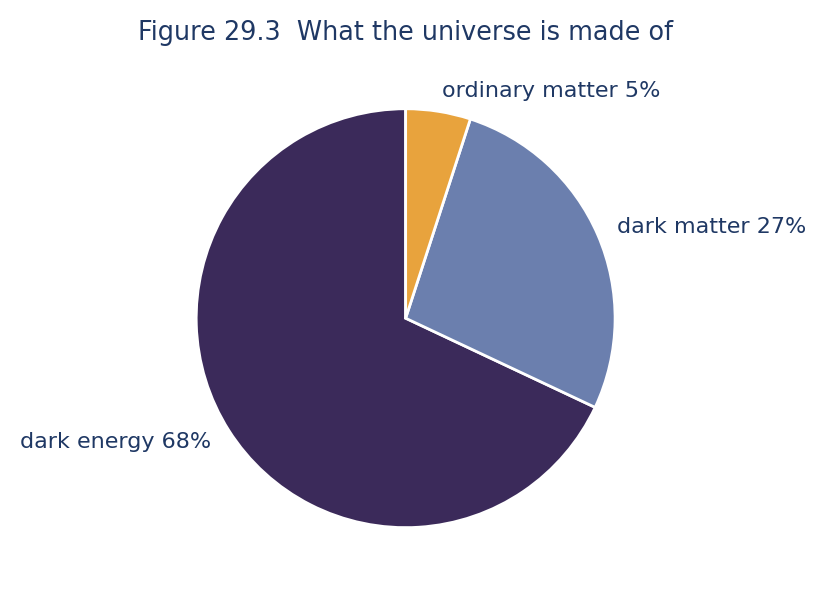
So the familiar matter of everyday life is only a few percent of everything, while dark matter and dark energy dominate. Understanding their nature is among the greatest unsolved problems in all of science, a humbling note on which to reach the frontier of what we know.
Chapter Summary
The expansion of the universe implies that it was once much smaller and denser, and measuring the expansion gives an age of about fourteen billion years. Running the expansion back leads to the Big Bang, a hot, dense beginning followed by an expansion of space itself. The strongest evidence is the cosmic microwave background, the faint leftover glow of the early universe, whose tiny variations seeded the galaxies. Ordinary matter makes up only a few percent of the universe; most is dark matter and, in the largest share, dark energy, which is speeding up the expansion, and whose nature is a great unsolved mystery.
Key Terms
Big Bang: the hot, dense beginning of the universe about fourteen billion years ago, followed by expansion
Age of the universe: about fourteen billion years, calculated from the rate of expansion
Cosmic microwave background: the faint leftover glow of the early universe that fills the sky, key evidence for the Big Bang
Dark energy: a mysterious form of energy, the largest component of the universe, causing the expansion to speed up
Review Questions
1. About how old is the universe, and how is that age found?
Answer: About fourteen billion years, calculated from how fast the universe is expanding.
2. What is the cosmic microwave background, and why is it important?
Answer: The faint leftover glow of the early universe filling the sky; it is the strongest evidence that the universe began hot and dense.
3. What are the three main components of the universe, from smallest to largest share?
Answer: Ordinary matter (a few percent), dark matter (more), and dark energy (the largest share).
Chapter 30. Life in the Universe
Adapted from OpenStax Astronomy 2e (CC BY-NC-SA 4.0). Complementary notes provided free of charge by E2 Innovations LLC for Virginia Research Institute.
Pairs with Lecture 5, Life in the Universe
Learning Objectives
After completing this chapter, you should be able to:
Describe the cosmic ingredients and conditions that life requires.
Explain the idea of a habitable zone and where life might be sought.
Describe the search for intelligent life beyond the Earth.
Having surveyed the whole universe, we return at last to ourselves and ask the oldest question of all: are we alone? This closing chapter looks at what life needs, where in the cosmos it might arise, and how we search for it.
30.1 The Cosmic Context for Life
Life on the Earth is built from ordinary chemical elements, chiefly carbon, oxygen, hydrogen, and nitrogen, and every one of these heavier elements was forged inside stars and scattered into space when they died. In this sense the whole of this course has been a prelude to life: the formation of elements in stars, their spreading through the interstellar medium, and their gathering into new stars and planets are the very processes that made life possible. We are, quite literally, made of the ashes of ancient stars.
30.2 Astrobiology
Astrobiology is the study of the possibility of life beyond the Earth. Life as we know it appears to require a few key things, above all liquid water, a source of energy, and the chemical building blocks. On the Earth, life is found in an astonishing range of harsh environments, from boiling springs to frozen deserts, which suggests life may be hardier and more adaptable than once thought. This widens the range of places worth searching, and the leading targets within our own solar system are Mars, which once had liquid water, and icy moons such as Europa, which may hide oceans beneath their crusts.
Beyond the solar system, astronomers focus on the habitable zone of a star, the range of distances where a planet could have liquid water on its surface, being neither too hot nor too cold. The discovery of many exoplanets, some in their stars’ habitable zones, has made the search for life on other worlds a realistic scientific goal.
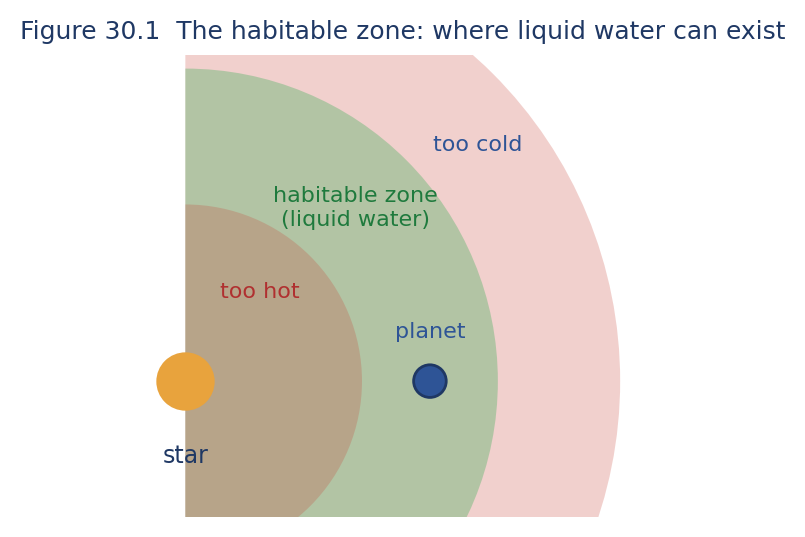
30.4 The Search for Extraterrestrial Intelligence
A separate effort looks not just for life but for intelligent, technological life. The search for extraterrestrial intelligence uses large radio telescopes to listen for signals that another civilization might send or leak into space. So far no confirmed signal has been found, and we do not know whether intelligent life is common or vanishingly rare. But given the staggering number of stars and planets revealed by this course, the question of whether we are alone is one of the most profound that science can ask, and a fitting place to end our journey through the universe.
Chapter Summary
Life is built from ordinary elements, carbon, oxygen, hydrogen, and nitrogen, all forged in stars and scattered at their deaths, so the star processes studied throughout this course are what made life possible. Astrobiology studies life beyond the Earth, which appears to require liquid water, energy, and chemical building blocks; the hardiness of life on the Earth widens the search, with Mars and icy moons like Europa as leading targets, and the habitable zone marking where exoplanets could have surface water. The search for extraterrestrial intelligence listens with radio telescopes for signals from other civilizations, and though none has been found, the vast number of stars and planets makes the question of whether we are alone one of the most profound in science.
Key Terms
Astrobiology: the study of the possibility and nature of life beyond the Earth
Habitable zone: the range of distances from a star where a planet could have liquid water on its surface
Extremophile: an organism on the Earth that thrives in harsh conditions, widening where life might exist
Search for extraterrestrial intelligence: the effort to detect signals from intelligent life elsewhere, using radio telescopes
Review Questions
1. Where did the elements that make up living things come from?
Answer: They were forged inside stars and scattered into space when the stars died.
2. What is a star’s habitable zone?
Answer: The range of distances where a planet could have liquid water on its surface, neither too hot nor too cold.
3. How does the search for extraterrestrial intelligence look for other civilizations?
Answer: By using large radio telescopes to listen for signals that another civilization might send or leak into space.